
@SFOMuseum Twitter Posts Tagged WingWednesday This is SFO Museum's archive of the @SFOMuseum Twitter account. There are 144 posts and this is page 8 of 12. See all the tags or all the Twitter posts that have been archived so far.
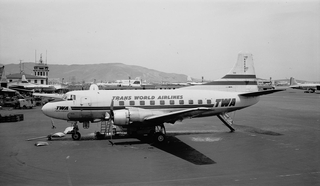
The Martin 4-0-4 was an upgraded, pressurized version of Martin's earlier 2-0-2 and included a redesigned wing. It had capacity for 40 passengers, a medium range, and a built-in air-stair for easy passenger loading and unloading at the tail section. #WingWednesday
This tweet was posted on May 19, 2021.
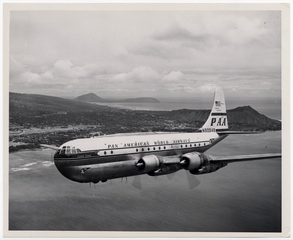
#PanAm launched Boeing 377 Stratocruiser service from San Francisco to Hawai’i in April 1949, and transatlantic service to London in June 1949 as all first-class “President” service. #WingWednesday
This tweet was posted on May 12, 2021.
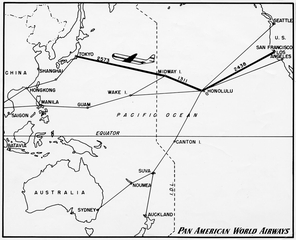
The aircraft’s four 28-cylinder Pratt & Whitney radial engines enabled the Stratocruiser, as its name asserted, to cruise in the stratosphere at over 300 miles per hour. With a range of just over 4,000 miles, the B-377 was ideally suited for transoceanic routes. #WingWednesday
This tweet was posted on May 12, 2021.
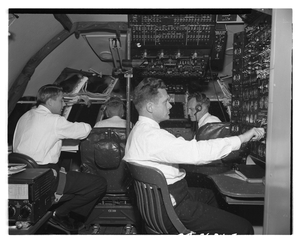
With nineteen windowpanes, the cockpit of the Boeing 377 offered one of the highest degrees of visibility of any airliner. #WingWednesday
This tweet was posted on May 12, 2021.
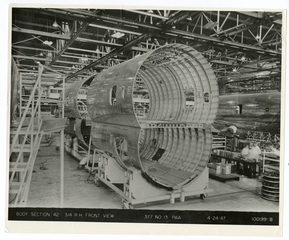
The Boeing 377's unique, pressurized, “double-bubble” fuselage was equipped with two decks: the upper contained a roomy main cabin, while the lower featured the highly popular cocktail lounge. #WingWednesday
This tweet was posted on May 12, 2021.
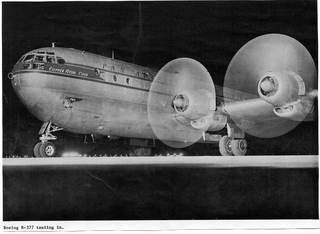
The Boeing 377 Stratocruiser was considered the most luxurious airliner aloft when introduced by Pan American World Airways in 1949. #WingWednesday
This tweet was posted on May 12, 2021.
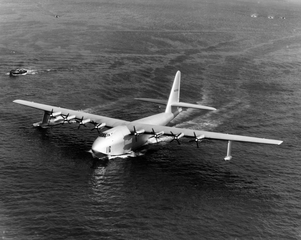
The one and only flight of the "Spruce Goose," which lasted only a minute and hit an altitude of 70 feet, took place on Nov. 2, 1947, off the coast of San Pedro, CA, with Howard Hughes at the controls, David Grant as copilot, and members of the press on board. #WingWednesday
This tweet was posted on May 05, 2021.
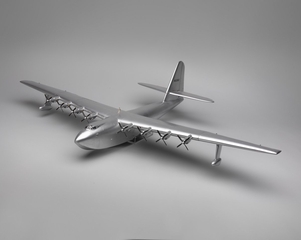
Despite the "spruce" nicknaming, the H-4 was actually constructed primarily of birch due to weight concerns and restrictions on the use of aluminum during WWII. Numerous delays prevented it from being completed before the end of the war. #WingWednesday #avgeek
This tweet was posted on May 05, 2021.
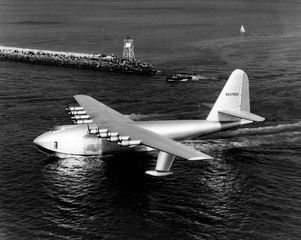
The Hughes H-4 Hercules flying boat, known as the “Spruce Goose,” was designed and built by the Hughes Aircraft Company as an ultra-large, transoceanic military transport for use during WWII. The massive flying boat remains the largest all-wood airplane built. #WingWednesday
This tweet was posted on May 05, 2021.
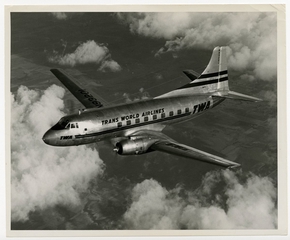
Though only 47 were built, the Martin 2-0-2 was flown by airlines such as Northwest Airlines, Pacific Air Lines, Trans World Airlines, and Allegheny Airlines. #WingWednesday #avgeek
This tweet was posted on April 28, 2021.
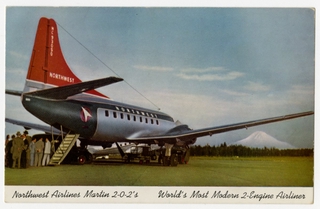
The unpressurized 2-0-2 had a capacity of 40 passengers and a maximum speed of 311 miles per hour, much faster than the DC-3. With a range of just over 600 miles, it was designed to compete with the Convair 240 on short domestic routes. #WingWednesday #avgeek
This tweet was posted on April 28, 2021.
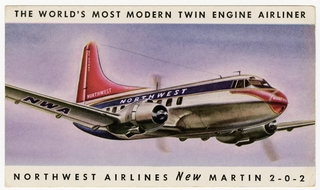
Developed by the Glenn L. Martin Company, the Martin 2-0-2 was intended to supersede the DC-3. Although early orders placed in 1945 were canceled due to production delays, the 2-0-2 was introduced into service by Northwest Airlines in October 1947. #WingWednesday #avgeek
This tweet was posted on April 28, 2021.