
@SFOMuseum Twitter Posts Tagged WingWednesday This is SFO Museum's archive of the @SFOMuseum Twitter account. There are 144 posts and this is page 11 of 12. See all the tags or all the Twitter posts that have been archived so far.
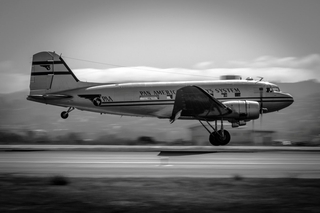
By 1940, nearly three million passengers had flown in DC-3s, and the aircraft had collectively logged over 100 million miles. By the end of production, more than 10,000 commercial and military transport versions had been built, and a few are still flown today. #WingWednesday
This tweet was posted on March 10, 2021.
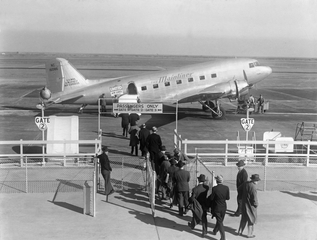
The DC-3 proved aerodynamically superior to other planes, highly reliable, safe, easy to maintain, and for the first time, enabled carriers to make a profit from passenger services. More than four hundred DC-3s were initially ordered by most major airlines. #WingWednesday
This tweet was posted on March 10, 2021.
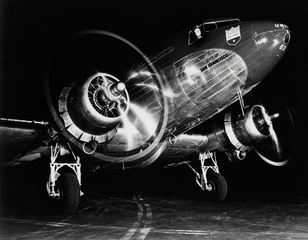
The Douglas DC-3 was arguably the most significant commercial airliner introduced prior to WWII. Introduced in 1936, it incorporated many advancements, including a strong, streamlined, all-aluminum, semi-monocoque fuselage, and a low-drag wing design. #WingWednesday #avgeek
This tweet was posted on March 10, 2021.
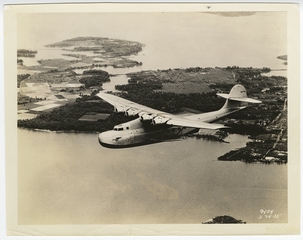
Shortly after its delivery in 1935, the China Clipper became famous when it inaugurated the first transpacific airmail service from San Francisco Bay to Manila Harbor. The next year, the Philippine Clipper inaugurated the first transpacific passenger air service. #WingWednesday
This tweet was posted on March 03, 2021.
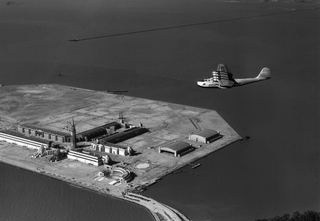
The Martin Model 130 also had a very large fuel capacity, which gave it a range of over 3,000 miles. Only three were built: the China Clipper, Philippine Clipper, and Hawaii Clipper. #WingWednesday #AvGeek
This tweet was posted on March 03, 2021.
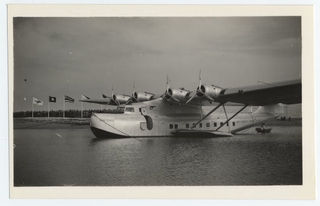
The Martin Model 130 flying boat was designed to meet #PanAm's requirements for a long-range, transoceanic aircraft to cross the expanse of the Pacific. It had a clean, aerodynamic design and was equipped with “sea wings” for buoyancy, instead of sponsons. #WingWednesday #AvGeek
This tweet was posted on March 03, 2021.
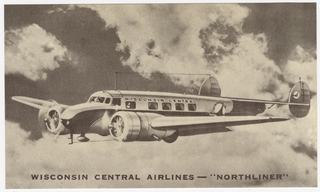
149 of the Lockheed Model 10 Electras were built in a variety of variants, the most famous arguably being the modified Model 10E flown by Amelia Earhart on her ill-fated attempted around-the-world flight. #WingWednesday #avgeek
This tweet was posted on February 24, 2021.
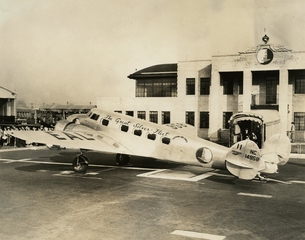
Named after a star in the Pleiades cluster, the Electra's sleek appearance is punctuated by its signature twin tail, which became a hallmark of Lockheed design. #WingWednesday #avgeek
This tweet was posted on February 24, 2021.
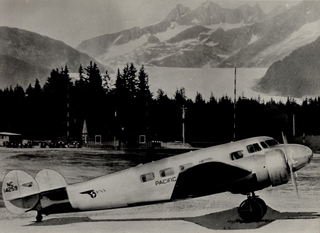
The Lockheed Model 10 Electra was introduced in 1935 as the manufacturer's first all-metal aircraft, developed to compete with the Douglas DC-2 and Boeing 247. #WingWednesday #avgeek
This tweet was posted on February 24, 2021.
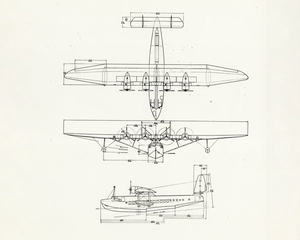
S-42 types conducted route survey flights in the Pacific and North Atlantic, along with serving many of the airline’s routes, including the Manila–Hong Kong leg of transpacific service to China in the late 1930s. #WingWednesday
This tweet was posted on February 17, 2021.
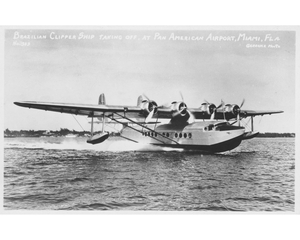
The Brazilian Clipper NC-822M was the first S-42 to enter service in 1934. It primarily flew #PanAm’s Latin American routes. Later upgraded versions included the S-42A and S-42B, which were equipped with more powerful engines and had a range of up to 2,800 miles. #WingWednesday
This tweet was posted on February 17, 2021.
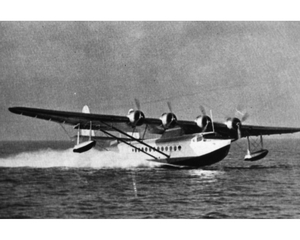
The Sikorsky S-42 was developed to meet requirements of #PanAm president Juan Trippe for a large, long-range, trans-oceanic flying boat. Designed by Igor Sikorsky, with input from Charles Lindbergh, it could carry a crew of 4 and 32 passengers up to 1,200 miles. #WingWednesday
This tweet was posted on February 17, 2021.