
@SFOMuseum Twitter Posts Tagged WingWednesday This is SFO Museum's archive of the @SFOMuseum Twitter account. There are 144 posts and this is page 6 of 12. See all the tags or all the Twitter posts that have been archived so far.
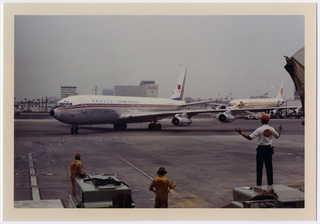
By the mid-1960s, the 707 had been acquired by a long list of carriers and could be seen regularly at airports across the globe. Over 800 of the 707 jetliners were eventually produced. #WingWednesday
This tweet was posted on June 23, 2021.
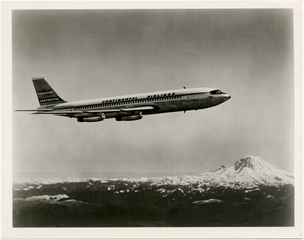
As a result of its reliability, capacity, and considerably reduced seat-mile cost, the 707 proved to be the world's first viable commercial jetliner with regular and sustained scheduled service, and revolutionized the airline industry by ushering in the jet age. #WingWednesday
This tweet was posted on June 23, 2021.
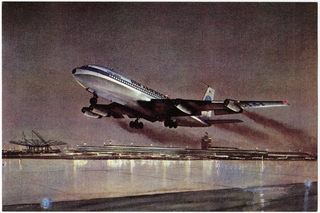
First flown in 1957, Pan Am introduced the jetliner in October 1958 by inaugurating 707-120 service from New York to Paris with one refueling stop in Newfoundland. #WingWednesday
This tweet was posted on June 23, 2021.
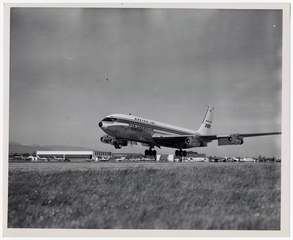
The Boeing 707 was originally developed following an initial request in 1955 from Pan American World Airways for a large capacity jet-powered airliner. #WingWednesday
This tweet was posted on June 23, 2021.
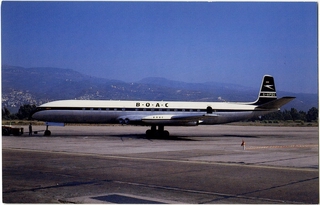
BEA inaugurated shorter-range Comet Mk. 4B service on its Tel Aviv-London route in April 1960. The Comet Mk. 4 had a cruising speed of just over 500mph and accommodated up to 81 passengers, but ultimately could not compete with the Boeing 707 or the Douglas DC-8. #WingWednesday
This tweet was posted on June 16, 2021.
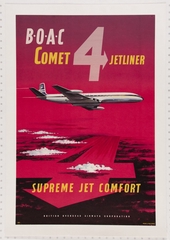
After many years of redesigning, the much-improved, lengthened, D.H. 106 Comet Mk. 4 was delivered to BOAC in 1958. Shortly after, the airline inaugurated regular transatlantic jet service from London to New York with one refueling stop in Newfoundland. #WingWednesday
This tweet was posted on June 16, 2021.
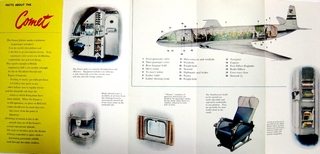
Initially seen as a major landmark in aeronautical engineering, after intermittent operation and several disastrous structural failures, service and production of the Comet were canceled until airframe engineering deficiencies could be corrected. #WingWednesday
This tweet was posted on June 16, 2021.
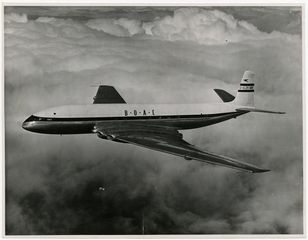
Introduced in 1952, the de Havilland D.H. 106 Comet was the first commercial passenger jetliner to enter service, years before the introduction of other jetliners. #WingWednesday
This tweet was posted on June 16, 2021.
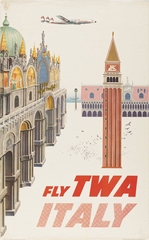
Forty-four L-1649 Starliners were produced and by the early 1960s, with the end of the propliner era, they were replaced by the much faster Boeing 707 jetliner. #WingWednesday
This tweet was posted on June 09, 2021.
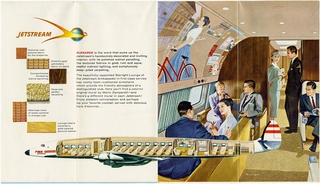
Named the “Jetstream” by TWA (Trans World Airlines), the L-1649 Starliner had a 100-passenger capacity and could cruise at a speed of 300 mph. Lufthansa and Air France were the only carriers besides TWA to operate it on the transatlantic route. #WingWednesday
This tweet was posted on June 09, 2021.
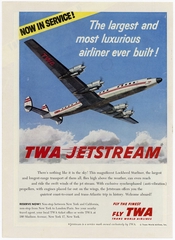
Initial deliveries of the L-1649 went to TWA, which inaugurated service on its New York, London, and Frankfurt route in June 1957. TWA also inaugurated trans-polar service between the U.S. West Coast and Europe with the Starliner the same year. #WingWednesday
This tweet was posted on June 09, 2021.
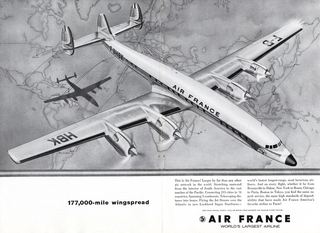
The fuselage of the L-1649 was similar to the L-1049, but the wings were redesigned. Lengthened, squared-off, and capable of carrying a large reservoir of fuel, the L-1649 had a range of 4,000-6,000 miles and offered an efficient low-drag, high-altitude airfoil. #WingWednesday
This tweet was posted on June 09, 2021.