
loading image

In 1963, American President John F. Kennedy announced the launch of a government-funded SST program to compete with the joint British and French Concorde project. Three proposed airframe designs were selected for review—the North American Aviation NAC-60, the Boeing 733, and the Lockheed L-2000. Aspects of Lockheed’s design were similar to those of the Concorde, including a long, highly streamlined nose section that could be dropped during landing and takeoff, a delta wing, and a long narrow body that could accommodate four to five passengers abreast. By 1967, Lockheed constructed a full-size display mockup of the L-2000 SST and was actively promoting the aircraft to the public and to major airlines. However, wind tunnel tests demonstrated the Lockheed design suffered from shifts in the aircraft’s center of pressure—the point where lift acts on the aircraft—as it accelerated. The transfer of fuel partially solved this problem, but it was ultimately rejected in favor of the Boeing design, which was renamed the 2707. See “Supersonic Transport: The First Generation” on display, pre-security, in the Aviation Museum and Library and online at: https://bit.ly/SSTFirstGeneration
This image was posted on February 09, 2023.
Similar Instagram posts
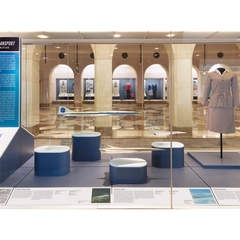
In 1963, the United States launched a government-funded Supersonic Transport (SST) program to compete with the joint British and French Concorde project.
This image was posted on March 21, 2023.
#sstfirstgeneration #avgeek #concorde
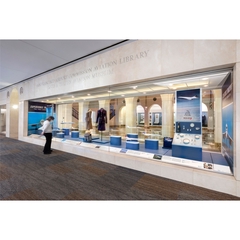
The Concorde’s Rolls-Royce/SNECMA Olympus 593 afterburning turbojet engines— a turbine-driven compressor that thrusts heated, compressed air through a propelling nozzle—were atypical.
This image was posted on January 19, 2023.
#sstfirstgeneration #avgeek #concorde
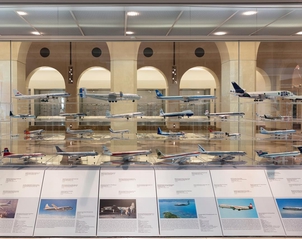
Introduced in 1952, the de Havilland Comet was the first commercial passenger jetliner to enter service, years before the introduction of other jetliners.
This image was posted on September 28, 2018.
#aviationevolutions #jimlund #avgeek #aviationgeek #aviation #aviationhistory #vintageaviation #history #aviationgeeks #modelplane #scalemodel #avgeeks #turboprop
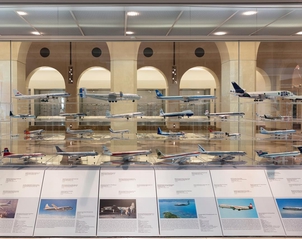
Introduced in 1952, the de Havilland Comet was the first commercial passenger jetliner to enter service, years before the introduction of other jetliners.
This image was posted on September 28, 2018.
#aviationevolutions #jimlund #avgeek #aviationgeek #aviation #aviationhistory #vintageaviation #history #aviationgeeks #modelplane #scalemodel #avgeeks #turboprop
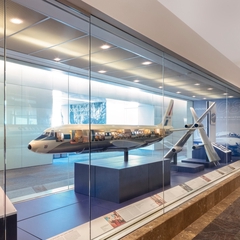
On this day in 1959, the DC-8 entered service with Delta Air Lines and United Air Lines.
This image was posted on September 18, 2023.
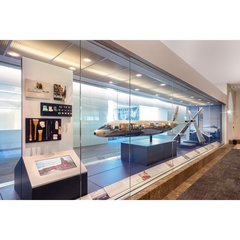
Sometimes even after objects go on display, they need a little love.
This image was posted on November 21, 2022.
#museummonday #conservation #behindthescenes #minimainliner #dc8
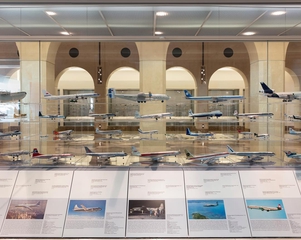
In an effort to compete with TWA (Trans World Airlines) on transatlantic routes to Europe, Pan American World Airways ordered the extended-range DC-7C (dubbed the “Seven Seas”) from Douglas Aircraft.
This image was posted on September 13, 2018.
#aviationevolutions #jimlund #avgeek #aviationgeek #aviation
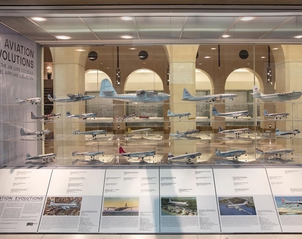
The Hughes H-4 flying boat, also known as the “Spruce Goose,” was designed and built by the Hughes Aircraft Company as an ultra-large, transoceanic military transport for use during World War II.
This image was posted on November 02, 2018.
#aviationevolutions #jimlund #avgeek #aviationgeek #aviation #aviationhistory #vintageaviation #history #aviationgeeks #modelplane #scalemodel #avgeeks #sprucegoose #howardhughes
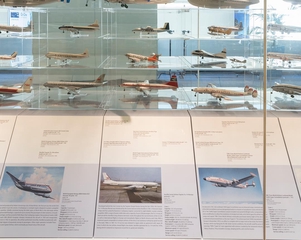
Introduced in 1951, the Lockheed 1049 Super Constellation was an enhanced-range, stretched upgrade of the 049 Constellation and was designed primarily to compete on transatlantic routes with the Douglas DC-6.
This image was posted on October 25, 2018.
#aviationevolutions #jimlund #avgeek #aviationgeek #aviation #aviationhistory #vintageaviation #history #aviationgeeks #modelplane #scalemodel #avgeeks