
loading image

This DC-3 seat typically used in day-use configurations was covered in fabric, amply cushioned, and represented the introduction of foam rubber on airliner seats. First created by Dunlop Rubber in 1929, foam rubber was used in many cushioning products by the late 1930s. The Firestone Tire and Rubber Company promoted its Foamex brand by claiming “nothing cuts flying fatigue like Foamex” and promising “resilience and softness in one zephyr-light material.” The seat is framed in aluminum tubing and features a spring-loaded pivot mechanism that simultaneously slides the seat forward while allowing the back to recline to thirty degrees from the normal upright setting of fifteen degrees. The chair also has plastic sidewalls giving it a clean, streamlined look. Some chairs aboard the DC-3 included holders under the seat for round paper cartons, commonly called burp cups, in case of motion sickness. Washable linen covers, known as antimacassars, were often fitted over the headrest to prevent hair oil from soiling the fabric. For extra comfort, airlines also offered passengers pillows and blankets. See “Remain Seated: Airliner Passenger Chairs,” on display, pre-security in the Aviation Museum and Library, located on the departures level of the International Terminal and online at: https://bit.ly/AirlinerChairs
This image was posted on November 17, 2023.
Similar Instagram posts
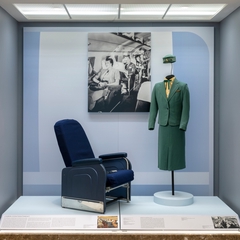
Introduced in 1936, the same year as the Douglas DC-3, this United Air Lines sage green wool stewardess uniform was worn with a yellow linen blouse and included a pillbox hat complemented with a green and yellow flat bow.
This image was posted on December 15, 2023.
#airlinerchairs
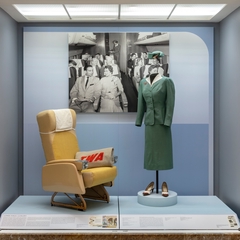
Introduced in 1955, the Lockheed L-1049G Super Constellation, also known as the “Super G,” was a longer-range upgrade variant of the Super Constellation.
This image was posted on January 31, 2024.
#airlinerchairs #aircraftinteriors #avgeek
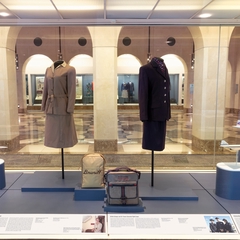
Flying on the Concorde at twice the speed of sound was an aviation experience like no other, even for flight crews who often found it nearly as exciting as the passengers.
This image was posted on May 09, 2023.
#sstfirstgeneration
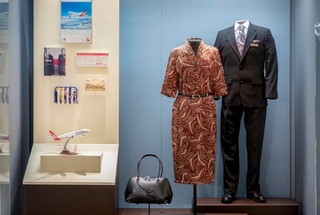
For the past twenty years, Qantas has upgraded and expanded the range of services offered on transpacific flights between Australia and North America, in addition to updating their look.
This image was posted on August 31, 2022.
#flyingsoutherncross #avgeek #qantas #uniform #crewlife
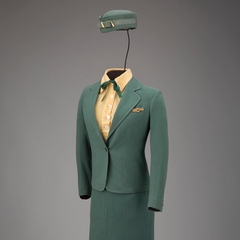
This 1936 #United Air Lines fall and winter suit in sage green wool was worn over a vivid yellow linen blouse.
This image was posted on November 09, 2016.
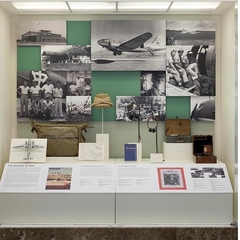
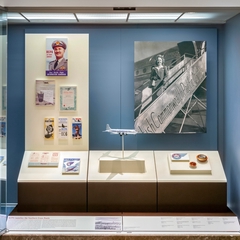
One of the first Australian airlines to operate transpacific commercial air services to America was BCPA (British Commonwealth Pacific Airlines) which was formed by the governments of Australia, Great Britain, and New Zealand in 1947.
This image was posted on February 16, 2023.
#flyingsoutherncross #australia #avgeek
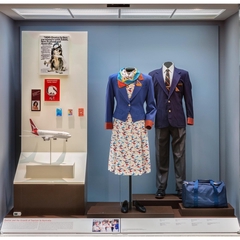
In the mid-1980s, Qantas introduced a new corporate look with a fresh livery for their aircraft, along with a new line of cabin and ground crew uniforms.
This image was posted on December 06, 2022.
#flyingsoutherncross #avgeek #qantas #uniform #crewlife