
loading image

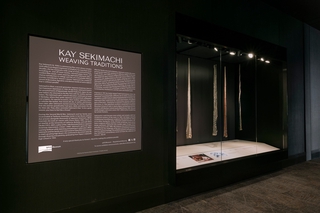
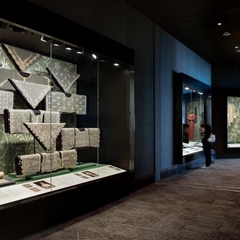
Building on the success of her loom-woven sculptures, in the 1970s Kay Sekimachi adapted nylon monofilament to the centuries-old, off-loom technique of card weaving. Sekimachi created a series of hanging sculptures that she named “River,” stating, “I thought of them as rivers because they were narrow and long and sometimes the warp threads were twisted and sort of hung free, and then they came together again.” To weave such long and complex shapes off the loom, Sekimachi employed a six-foot-long, cribbage-like board made by her husband, the master woodturner Bob Stocksdale (1913–2003), that could accommodate up to 400 warp threads and 100 cards. With her preference to focus on one media and technique at a time, Sekimachi then substituted linen for monofilament and created the Marugawa series of card-woven tubes, naming them for a Japanese word that translates to “round river.” A very special thank you to Forrest L. Merrill for making this exhibition possible. See "Kay Sekimachi: Weaving Traditions" on display, post-security, in Harvey Milk Terminal 1 or online at: https://bit.ly/WeavingT
This image was posted on May 15, 2024.
Similar Instagram posts

Fiber artist Kay Sekimachi is Nisei, a second-generation Japanese American, born in San Francisco’s Japantown in 1926.
This image was posted on November 15, 2023.
#kaysekimachiweaving
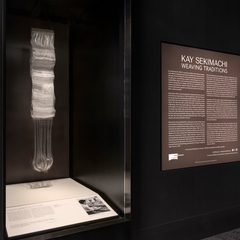
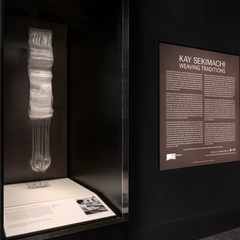
Fiber artist Kay Sekimachi’s series of monofilament sculptures began in 1963 as an experiment to weave a wall hanging in multiple, translucent layers.
This image was posted on March 11, 2024.
#kaysekimachiweaving #kaysekimachi #weaving #5womenartists #womenshistorymonth
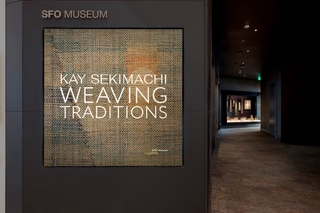
Fiber artist, Kay Sekimachi is Nisei, a second-generation Japanese American, born in San Francisco’s Japantown in 1926.
This image was posted on May 01, 2024.
#kaysekimachiweaving #kaysekimachi #weaving #aapihm
The Aviation Museum and Library will be closed today to celebrate Juneteenth and will reopen tomorrow, June 20th at 10am.
This image was posted on June 19, 2024.
#juneteenth
The pineapple plant, known all over the world for its delicious fruit, is indigenous to Central and South America.
This image was posted on April 26, 2022.
#pineappletopina #pineapple #lace #fashion #design #phillipines #textile