
loading image

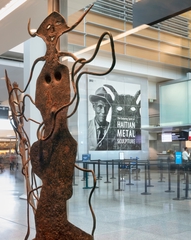
Vibrant art traditions can be found across cemeteries of Africa and the African Diaspora–indeed, it is here that the ancestors reside and are memorialized by their descendants. The cross is often identified as Christianity’s most iconic emblem, and in a nation such as Haiti colonized by French Catholics, it appears frequently in Haitian religious iconography. However, Haitian crosses also have deep historical roots in the dikenga, an Indigenous symbol of the ancient Kongo Kingdom. In Central Africa, the Kongo cross or dikenga has signified the cosmic crossroads between mortal and spiritual realms, a cosmogram representing dimensions of both time and space in the mystic encounter between worlds. Kongolese citizens Africanized the Catholic tradition between the sixteenth and nineteenth centuries and claimed the cross as their own religious symbol. Similarly today in Haiti, the cross represents the nation’s plural religious realities, simultaneously embodying the presence of Jesus Christ for Christians as readily as the Gede spirits of life, death, and rebirth for Vodouizan (devotees). —Dr. Kyrah Malika Daniels, Assistant Professor of African American Studies at Emory University See “The Enduring Spirit of Haitian Metal Sculpture” on display, pre-security, in the Mayor Edwin M. Lee International Terminal Departures Hall and online at: https://bit.ly/HaitianMetal
This image was posted on September 27, 2024.
Similar Instagram posts
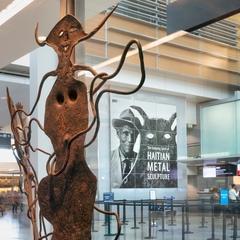
This is your last week to see “The Enduring Spirit of Haitian Metal Sculpture” on display!
This image was posted on October 16, 2024.
#haitianmetal
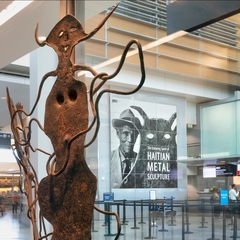
The Aviation Museum and Library will be closed tomorrow to observe Independence Day and will reopen on July 5th at 10am.
This image was posted on July 03, 2024.
#independenceday
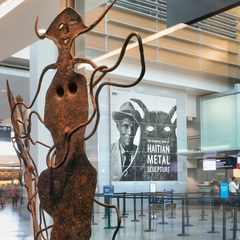
Steel oil drum containers were initially left behind by U.S. Marines between 1915 and 1934 during the United States’ occupation of Haiti following the assassination of Haiti’s president Jean Vilbrun Guillaume Sam (1859–1915) in 1915.
This image was posted on October 18, 2023.
#haitianmetal #georgesliautaud #haitianmetalarts #haiti
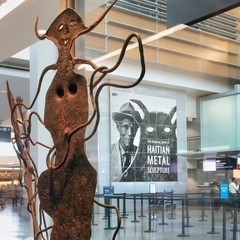
To create his sculptures, visionary Haitian artist, Georges Liautaud (1899–1991) first made a rough drawing on paper, or simply drew the shape of the figure freehand onto the metal.
This image was posted on November 14, 2023.
#haitianmetal
The Aviation Museum and Library is closed today to observe Indigenous Peoples’ Day and will reopen tomorrow, October 10th at 10am.
This image was posted on October 09, 2023.
#indigenouspeoplesday