
loading image

First flown in 1957, the Boeing 707 was the first successful jet airliner to provide regular, sustained commercial passenger service. The aircraft was developed by Boeing after a 1955 request from Pan American World Airways for a large-capacity, long-range, jet-powered airliner. Within its long, narrow fuselage the jetliner’s cabin had an initial capacity of up to 175 passengers. On its low, sweptback wings were mounted four turbojet engines that could power the airliner to cruising velocities approaching six hundred miles per hour. With its speed, reliability, large capacity, and reduced operating costs, the 707 revolutionized the airline industry and helped usher in the jet age of commercial aviation. Although primarily designed as a fast, long-haul transoceanic jetliner, the Boeing 707 was also purchased and leased by numerous U.S. carriers for their regional and transcontinental services. Continental Airlines’ president Robert Six (1907–86) wanted Continental’s 707 airliner to be something unique. He conceived of the idea of painting the large vertical stabilizers gold and naming the airliners “Golden Jets.” He even had the name registered as a trademark. Continental ordered gold-toned hardware from Boeing for the bathrooms and had the seats upholstered in fabric of gold mixed with reds and warm blues. The airline’s stewardesses, then referred to as hostesses, marked the jetliner’s arrival dressed in newly designed uniforms. See “A Cut Above: Airplane Models from the SFO Museum Collection” on display, pre-security, in the Mayor Edwin M. Lee International Terminal Departures Hall and online at: https://bit.ly/CutAboveModels 📸: Continental Airlines Boeing 707 brochure [detail] early 1960s paper, ink Collection of SFO Museum Gift of M.D. Klaas 2018.112.1192 R2024.0401.022 Continental Airlines Boeing 707 flight information packet folder cover (detail) c. 1960 paper, ink Collection of SFO Museum Gift of Thomas G. Dragges 2014.095.427 a R2024.0401.021
This image was posted on October 04, 2024.
Similar Instagram posts
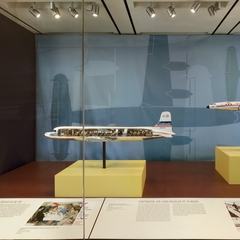
The DC-7 was Douglas Aircraft’s final design evolution of the piston-powered, four-engine, low-wing airliner concept that began with the DC-4 in the 1940s.
This image was posted on May 03, 2024.
#cutabovemodels
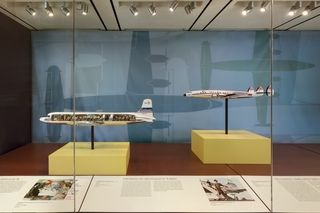
This model of the Continental Air Lines Douglas DC-7B City of Los Angeles was crafted by Gary Field (b.
This image was posted on June 24, 2024.
#cutabovemodels
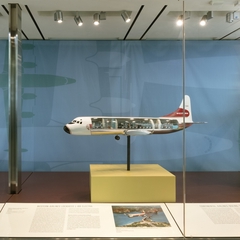
Developed by the Lockheed Corporation, the L-188 Electra was the only large turboprop airliner produced in the U.S.
This image was posted on August 23, 2024.
#cutabovemodels
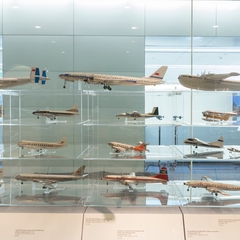
Developed behind the Iron Curtain by the Tupolev Design Bureau during the late 1950s, the massive Tu-114 Rossiya (Russia) turboprop airliner was introduced by the Soviet national airline Aeroflot in 1961.
This image was posted on February 20, 2018.
#aviationevolutions #jimlund #avgeek #avationgeek #aviation #aviationhistory #aviationlovers #vintageaviation #history #avhistory #aviationgeeks #instaplane #flying #modelplane #flight #airline #avgeeks #aviation4u #aviationdaily #modelaircraft #airplane #aircraft
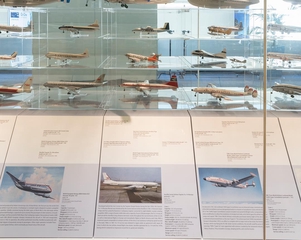
Introduced in 1951, the Lockheed 1049 Super Constellation was an enhanced-range, stretched upgrade of the 049 Constellation and was designed primarily to compete on transatlantic routes with the Douglas DC-6.
This image was posted on October 25, 2018.
#aviationevolutions #jimlund #avgeek #aviationgeek #aviation #aviationhistory #vintageaviation #history #aviationgeeks #modelplane #scalemodel #avgeeks
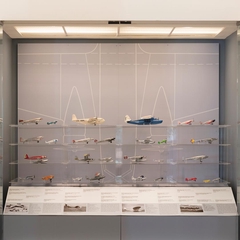
Introduced in the late 1930s, the British-produced Short S.30 series of aircraft was a large-capacity double-deck flying boat.
This image was posted on January 17, 2019.
#aviationevolutions #jimlund #avgeek #aviationgeek #aviation #aviationhistory #vintageaviation #history #aviationgeeks #modelplane #scalemodel #avgeeks #auckland #sydney #teal
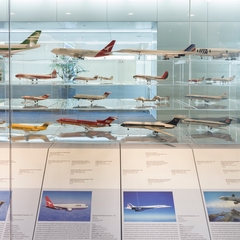
The DC-10 was McDonnell Douglas’ answer to Boeing’s wide-body 747 jumbo-jet.
This image was posted on June 21, 2018.
#aviationevolutions #jimlund #avgeek #avationgeek #aviation #aviationhistory #vintageaviation #history #avhistory #aviationgeeks #modelplane #avgeeks #modelaircraft #airplane #aircraft #dc10
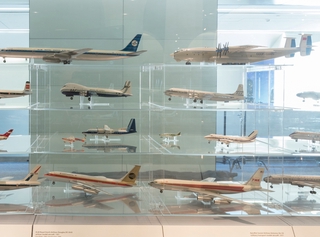
First flown in 1957, the Boeing Model 707 was the first US-made, pure-turbojet airliner to be introduced.
This image was posted on January 24, 2018.
#aviationevolutions #jimlund #avgeek #avationgeek #aviation #aviationhistory #aviationlovers #vintageaviation #history #avhistory #aviationgeeks #flying #modelplane #avgeeks #modelaircraft #airplane #aircraft #boeing #boeing707 #twa