
loading image

Once ubiquitous in Chinese dress, hats were worn on most public occasions. Historically, one’s rank, the occasion, and time of year dictated the type of hat worn. Hats, often displayed on decorative stands, were scented with fragrant materials that diffused through hollows to impart the owner’s hat with a pleasant scent. Crafted from materials including lacquered wood, bronze, and clay, hat stands were decorated with a variety of motifs. Many hat stands and other ceramic objects display auspicious figures, such as the Three Star Gods, including Fuxing, God of Blessings, who carries a baby or is accompanied by children, Luxing, God of Wealth and Rank, depicted as an official wearing a court robe, and Shoulao, God of Longevity, who has a prominent cranium, carries a staff, and holds a peach of immortality. The Eight Immortals—each awarded immortality by completing acts of great nobility—represent different aspects of life, such as wealth, youth, old age, and wisdom. Even today, these figures and other folk deities are regarded as powerful agents of good fortune. Special thank you to Sally Yu Leung and Guangzhen Zhou for making this exhibition possible, and to Dr. William Ma, Assistant Professor, College of Art & Design, Louisiana State University, for his curatorial contributions. See "Everyday Elegance in Chinese Ceramics" on display, pre-security, in the Mayor Edwin M. Lee International Terminal Departures Hall and online at: https://bit.ly/Chinese-Ceramics
This image was posted on November 01, 2024.
Similar Instagram posts
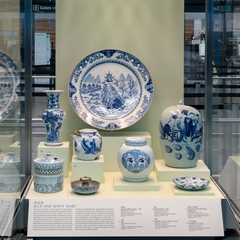
During the fourteenth century, Chinese ceramicists at the kilns at Jingdezhen, located in the southeastern province of Jiangxi, refined and perfected the art of porcelain painted with cobalt-blue decoration.
This image was posted on September 05, 2024.
#chineseceramics
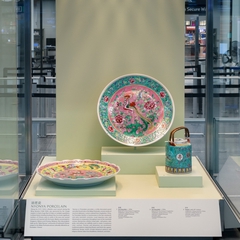
Zheng He (1371–1433), a Muslim court eunuch during the Ming dynasty (1368–1644), was sponsored by the Yongle emperor to lead a fleet of ships on multiple expeditions to distant lands, including Southeast Asia.
This image was posted on July 26, 2024.
#chineseceramics
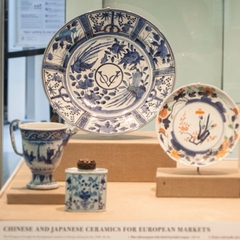
Part of the 17th century ceramics trade: a Japanese-made plate with the monogram of the Dutch East India Company.
This image was posted on May 29, 2013.
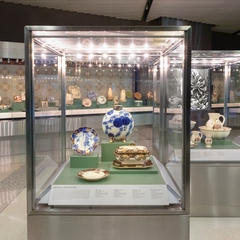
Following the peak of their popularity in the West during the 1880s, Japanese designs continued to provide inspiration to the Art Nouveau movement at the turn of the twentieth century in Europe and the United States.
This image was posted on November 28, 2022.
#japonisme #japan #design
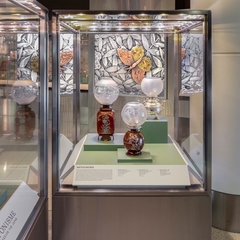
The Gorham Manufacturing Company, along with Tiffany & Company, was a leading manufacturer of precious metals at the height of Japonisme in the late 19th century.
This image was posted on January 18, 2023.
#japonisme #japan #design #metalwork
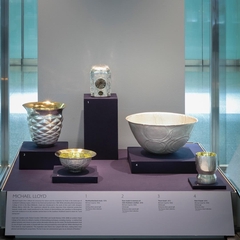
"Behind the world of the artisan is…that desire to take an inanimate material, and bring it to life in a form or image that will sing out; that desire to pay homage to my surroundings, to my creativity; that thanksgiving to that first bite into the apple of awareness."
This image was posted on December 14, 2018.
#britishsilver #silver #sterling #sterlingsilver #silverdesign #silver #silversmith #silversmithing #michaellloyd #vase
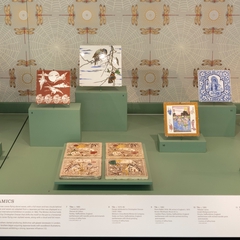
This tile shows three cranes flying above waves, with a full moon and two clouds behind them.
This image was posted on February 07, 2023.
#japonisme #japan #design #tile #ceramics #transferware
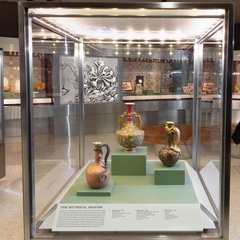
Japanese art was influenced by other Eastern countries, such as China and India.
This image was posted on December 13, 2022.
#japonisme #japan #design #dragon #ceramics