
loading image

In 1869, Andrew Hallidie (1836–1900) observed passenger-carrying horses struggling on wet cobblestones as they made the trek up San Francisco’s Jackson Street. As a result, Hallidie created a steam-engine-powered, wire-cable driven rail system to take passengers up the city’s steep hills. His father, an inventor, had patented the “wire rope” cable in Britain that Hallidie employed in his cable cars. Hallidie tested his first car in August of 1873, and his Clay Street Hill Railroad began public service in September. In the late 1870s and ’80s, several competing cable car lines emerged. The 1906 earthquake and fires reduced many of the rail lines to rubble. Most cars on the California Street line burned. Many of the Market Street cable cars operating west of Van Ness Avenue that survived the earthquake were converted to temporary housing. See “San Francisco: City of the World” on display, post-security, in Terminal 2 and online at: https://bit.ly/SFCityOfTheWorld SFO Museum respectfully acknowledges that we are on the unceded ancestral homeland of the Ramaytush Ohlone—the original, present, and future inhabitants and stewards of the San Francisco Peninsula. Please join us in recognizing and honoring Ramaytush Ohlone ancestors, descendants, and all Indigenous communities who have inhabited the Bay Area for hundreds of generations. 📸: Clay Street Hill Cable Car line c. 1873 San Francisco History Center, San Francisco Public Library AAC-7879; R2024.0529.010 Bay and Taylor cable car model c. 1950s Courtesy of Cavallini & Co. Archives L2024.0501.008 Powell/Mason cable car model c. 1950s SFO Museum 1999.619.001; L2024.0519.003 Cable car models c. 1950s Courtesy of Mickey McGowan L2024.0510.001-.007, .048
This image was posted on November 05, 2024.
Similar Instagram posts
This image was posted on September 10, 2015.
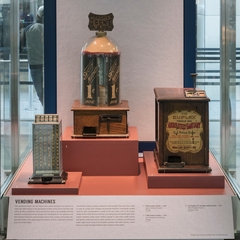
Coin-operated vendors did not require their owner-operator to be present for every sale.
This image was posted on January 19, 2018.
#coinoperated #theautomaticage #coinop #vintage #antique #matches #slotmachine #slotmachines #vendingmachine
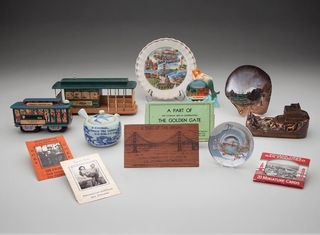
In honor of our 40th anniversary, every week this year we are highlighting one
of our past exhibitions.
This image was posted on September 17, 2020.
#sfomat40 #tbtsfom #museumfromhome
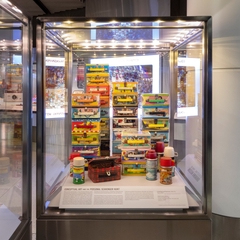
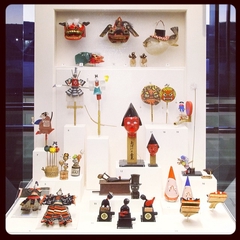
Many of the assemblages in the Unknown Museum were conceived as conceptual art, inviting people to embark on their own unique “personal scavenger hunt.” When confronted with so many common objects from years past, visitors often asked curator, Mickey McGowan, to see a specific item, and then proceeded to search for it among a multitude of similar things.
This image was posted on November 30, 2023.
#unknownmuseum #mickeymcgowan #bayarea #bayareahistory
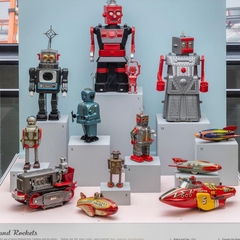
The 1950s were the golden age of space-themed toys.
This image was posted on April 18, 2019.
#1950sconsumer #1950s #robots #50s #midcentury #toys #space
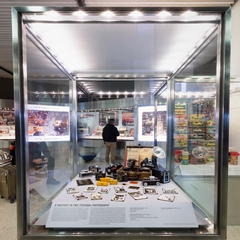
Personal photography provides snapshot glimpses of our daily lives.
This image was posted on October 25, 2023.
#unknownmuseum
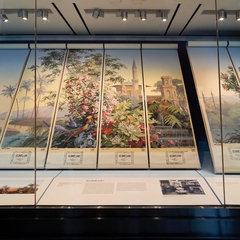
Eldorado (1849), one of the most popular scenic wallpapers created by Zuber et Cie, showcases the continents of Africa, Asia, Europe, and North America through both natural scenery and stunning architectural elements.
This image was posted on September 13, 2019.
#zuberscenicwallpaper #wallpaper #zuber #scenicwallpaper #interiordesign #museum #design