
loading image

Before Glenn Curtiss (1878-1930) shifted his attention to aviation, he was one of the first manufacturers to design motorcycles that significantly improved on their bicycle heritage. An avid bicyclist and racer himself, he ran a small manufacturing and retail shop in Hammondsport, New York, in the late 1890s. Sometime around 1901, Curtiss motorized two of his bicycles with engine castings made by the E.R. Thomas Company. Disappointed with engines’ performance, he decided to design and manufacture his own. In 1902, he advertised single-cylinder motorcycles, engines, and casting kits under the Hercules brand name, and the following year he was winning races on a powerful new twin-cylinder machine. In 1904, Curtiss made a twin-cylinder Hercules capable of an impressive five to fifty miles-per-hour. He soon dropped the Hercules name in favor of Curtiss and in January 1907, he entered a specially modified racing motorcycle fitted with the new V-8 aircraft engine at the Winter Speed Carnival in Ormond Beach, Florida. Amazingly, he clocked 136 miles-per-hour—the fastest speed anyone had achieved on a motorized vehicle—on the hard-packed sand before the motorcycle’s driveshaft broke while traveling over ninety miles-per-hour on the return run. “Early American Motorcycles” is on view pre-security in the International Terminal Main Hall and online - link in bio. While you're on our website, check out our new online-only exhibition catalog!
This image was posted on March 19, 2021.
Similar Instagram posts
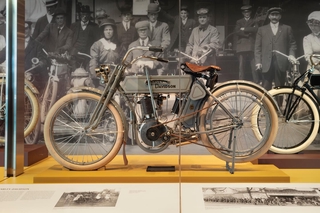
Harley-Davidson survives as the only continuously operating company of the approximately 100 motorcycle manufacturers that existed in the United States during the early twentieth century.
This image was posted on April 02, 2021.
#earlyamericanmotorcycles #motorcycle #vintagemotorcycle #harleydavidson
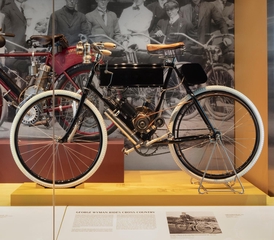
EPIC STORY ALERT!
This image was posted on March 05, 2021.
#earlyamericanmotorcycles #motorcycle #motorcycletouring #vintagemotorcycle #sfhistory
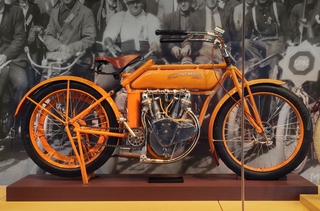
Joseph Frederic Merkel (1872–1978) road-tested his first motorcycle in 1900.
This image was posted on September 08, 2021.
#earlyamericanmotorcycles #motorcycle #vintagemotorcycle #flyingmerkel
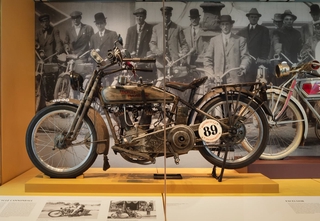
Effie (1889–1966) and Avis (1863–1958) Hotchkiss were the first women to ride across the United States on a motorcycle.
This image was posted on August 13, 2021.
#earlyamericanmotorcycles #motorcycle #vintagemotorcycle #womenwhoride
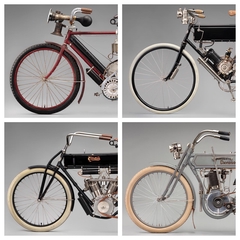
New exhibition alert!
This image was posted on February 12, 2021.
#earlyamericanmotorcycles #motorcycle #industrialdesign
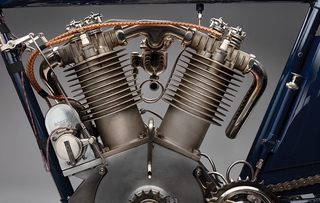
To no surprise, racing began almost as soon as motorcycles were introduced to the market, and the first organized race was held in 1901 at Agriculture Park in Los Angeles.
This image was posted on June 03, 2021.
#earlyamericanmotorcycles #motorcycle #vintagemotorcycle #jeffersonmotorcycle #motorcycleracing