
loading image

Nature served as a driving force of the Art Nouveau movement, inspiring designers throughout Europe and North America. During the nineteenth century, a multitude of illustrated botanical and biological publications spread knowledge on a variety of flora, fauna, and sea life and allowed students to copy natural imagery. While many Art Nouveau artists took a realistic approach in their interpretations of nature, others created more fanciful designs, with natural imagery appearing in a mysterious, serpentine, dream-like state. See more gorgeous Art Nouveau pieces in “The Allure of Art Nouveau: 1890-1914”, on display, pre-security, in the International Terminal.
This image was posted on March 01, 2016.
Similar Instagram posts
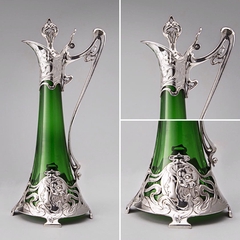
The malleability and brilliance of silver lent itself to the style of Art Nouveau.
This image was posted on June 08, 2016.
#artnouveausfo
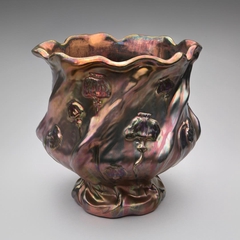
Ceramic artist Delphine Massier was known for his large jardinières and stands modeled in relief with Art Nouveau maidens, flowers, and scrolling foliage in shades of bold pink or blue.
This image was posted on August 09, 2016.
#artnouveausfo
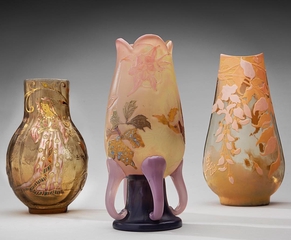
One of the most significant figures in the Art Nouveau movement, glassmaker Emile Gallé (1846–1904) combined naturalistic designs with innovative techniques.
This image was posted on May 13, 2016.
#artnouveausfo
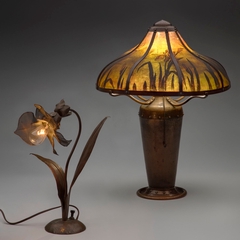
Lillian Palmer (1871–1961), undeterred by a lack of formal training, began crafting metalwork in copper, lead, and brass in 1907.
This image was posted on June 25, 2017.
#sfoartsandcrafts #artsandcraftsmovement #artsandcraftsstyle #craftsmanstyle #craftsmanhome #bungalowstyle #lilianpalmer #queerhistory #queerart #queerarthistory #lgbtpridemonth #lgbt #lgbtarthistory #lgbthistory #sfhistory #lamps #metalwork #localhistory #bayareahistory #queerartist #lgbtartist #happypridemonth #pride2017
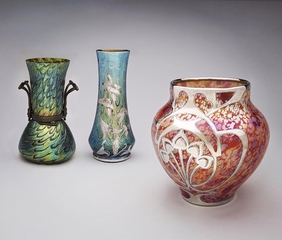
Discoveries of ancient Roman glass inspired late nineteenth-century artists to produce similarly lustrous glass.
This image was posted on March 31, 2016.
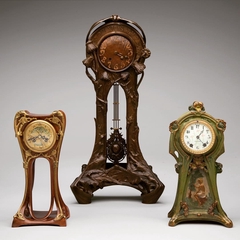
Master Art Nouveau furniture designer Louis Majorelle (1859–1926) offered clocks in addition to larger furnishings.
This image was posted on April 25, 2016.
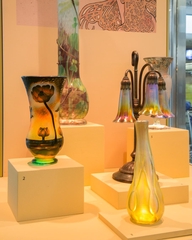
In New York, the most prominent Art Nouveau artist was Louis Comfort Tiffany.
This image was posted on May 16, 2016.
#artnouveausfo