
loading image

Marguerite Wildenhain enrolled in the Berlin School of Fine and Applied Arts where she studied drawing and sculpture. Feeling discontent, she left school to work as a designer for a porcelain factory in the small town of Rudolstadt. At the factory, Wildenhain felt hypnotized while observing artisans throwing models on the potter’s wheel. Later, while exploring the town of Weimar on her day off work, she encountered a manifesto penned by Walter Gropius, who founded one of the most influential arts schools of all time—the Bauhaus. In the decree, Gropius expressed his desire to “create a new guild of craftsmen without class distinctions which raise an arrogant barrier between craftsman and artist.” Fascinated by the radical proclamation, Wildenhain was among the first to enroll as a student of the Bauhaus school in 1919. Encouraged by sculptor Gerhard Marcks (1889–1981), she joined the school’s pottery workshops and studied with both Marcks and master potter Max Krehan (1875–1925). For seven rigorous years, she served as an apprentice-in-residence at the Bauhaus. An intensely dedicated student, she quickly advanced and began assisting her mentors. Many students sought guidance from her over the years, including Frans Wildenhain (1905–1980), whom she married in 1930. In 1926, Wildenhain became the first woman to achieve master potter status in Germany. Learn more about Wildenhain in "A Potter's Life: Marguerite Wildenhain at #PondFarm", post-security, in Terminal 2. http://bit.ly/PondFarm
This image was posted on August 10, 2016.
Similar Instagram posts
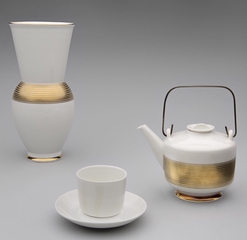
Marguerite Wildenhain accepted a position as head of ceramics at the Municipal School of Fine and Applied Arts in Halle, Germany, in 1926.
This image was posted on January 06, 2016.
#pondfarm
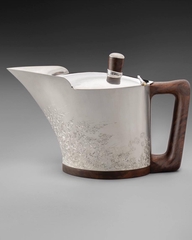
"Making and creating is part of my daily cycle…The making process is an inspiration in itself.
This image was posted on November 01, 2018.
#britishsilver #silver #sterling #sterlingsilver #silverdesign #silver #silversmith #silversmithing #teapot #edinburgh #british #britain
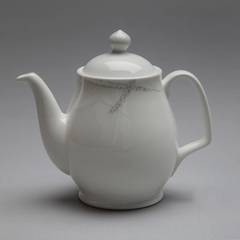
Our online database features highlights from our #mealservice collection.
This image was posted on December 24, 2018.
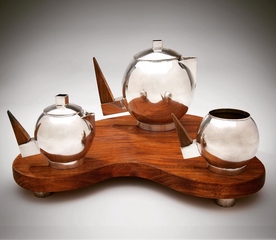
Born in Northern California and raised in Italy, jeweler and sculptor Peter Macchiarini (1909–2001) trained at the Art Academy in Pietrasanta in marble carving and ornamental art.
This image was posted on January 19, 2017.
#midcentury #modern #design #petermacchiarini #sfartist #sfhistory#sfarthistory
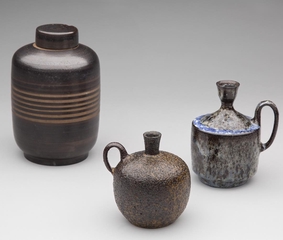
Marguerite Wildenhain went to work at the Municipal School of Fine and Applied Arts in 1926 where she headed the school’s ceramics department for seven years.
This image was posted on January 20, 2016.
#pondfarm
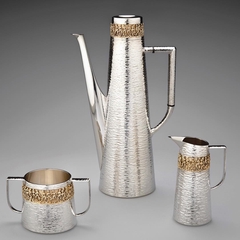
"I felt that the nature of my craft and the romance of precious metals gave me an opportunity to design pieces that added delight, surprise, intrigue and even amusement to what had become austere and even sterile within the ‘modern’ idiom of design."
This image was posted on October 16, 2018.
#britishsilver #silver #sterling #sterlingsilver #silverdesign #silver #silversmith #silversmithing
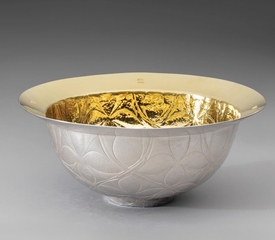
"Behind the world of the artisan is…that desire to take an inanimate material, and bring it to life in a form or image that will sing out; that desire to pay homage to my surroundings, to my creativity; that thanksgiving to that first bite into the apple of awareness."
This image was posted on November 09, 2018.
#britishsilver #silver #sterling #sterlingsilver #silverdesign #silver #silversmith #silversmithing #bowl #handmade