
loading image

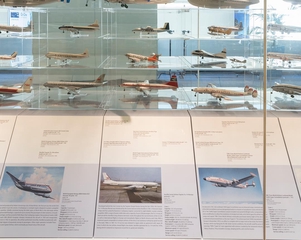
The Stinson Model A was one of the last commercial airliners produced in the United States with a steel-tube and fabric fuselage. Although the design was already outdated by the time it was introduced in 1935, it was still a relatively successful short-range, medium-capacity, tri-motor airliner. With a cruising speed of over 160 miles per hour, it was one the fastest tri-motor airliners available at the time and nearly as fast as the Douglas DC-2, which was introduced a year earlier. During the mid-1930s, it was primarily operated by American Airlines on the carrier’s five-stop Detroit–Chicago route, and later, the Washington D.C.–Chicago route. Other operators in the U.S. included Delta Air Lines and Central Airlines. See "Aviation Evolutions: The Jim Lund 1:72 Scale Model Airplane Collection", which features more than 200 models, on display, pre-security, in the Aviation Museum. http://ow.ly/bl8650jjq5O
This image was posted on October 03, 2018.
Similar Instagram posts
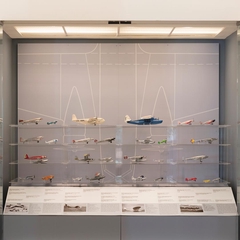
Introduced in the late 1930s, the British-produced Short S.30 series of aircraft was a large-capacity double-deck flying boat.
This image was posted on January 17, 2019.
#aviationevolutions #jimlund #avgeek #aviationgeek #aviation #aviationhistory #vintageaviation #history #aviationgeeks #modelplane #scalemodel #avgeeks #auckland #sydney #teal
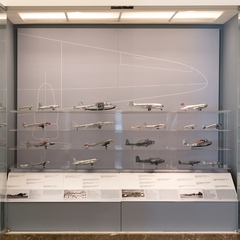
The Lockheed Model 12 Electra was similar to the Model 10 Electra in design, but smaller and faster.
This image was posted on April 26, 2018.
#aviationevolutions #jimlund #lockheed #electra #continental #avgeek #avationgeek #aviation #aviationhistory #aviationlovers #vintageaviation #history #avhistory #aviationgeeks #instaplane #flying #modelplane #flight #airline #avgeeks #aviation4u #aviationdaily #modelaircraft #airplane #aircraft
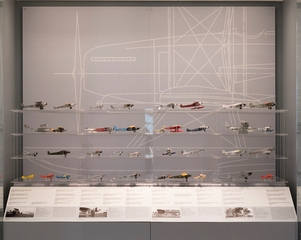
The all-metal Ford Tri-Motor, or “Tin Goose,” as it was nicknamed, had a substantial impact on the early advancement of commercial aviation in the late 1920s.
This image was posted on August 30, 2018.
#aviationevolutions #jimlund #avgeek #aviationgeek #aviation #aviationhistory #vintageaviation #history #aviationgeeks #modelplane #scalemodel #avgeeks #fordtrimotor #1920s
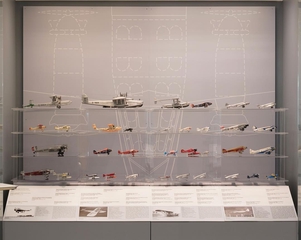
The Sikorsky S-40 was developed in response to requests from Pan American Airways’ president Juan T. Trippe for a high-capacity flying boat.
This image was posted on January 28, 2019.
#aviationevolutions #jimlund #avgeek #aviationgeek #aviation #aviationhistory #vintageaviation #history #aviationgeeks #modelplane #scalemodel #avgeeks
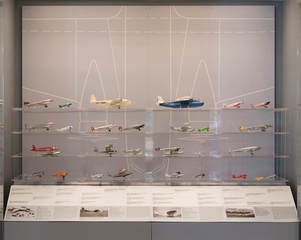
The Douglas DC-3 was arguably the most significant commercial airliner introduced before World War II.
This image was posted on February 07, 2019.
#aviationevolutions #jimlund #avgeek #aviationgeek #aviation #aviationhistory #vintageaviation #history #aviationgeeks #modelplane #scalemodel #avgeeks
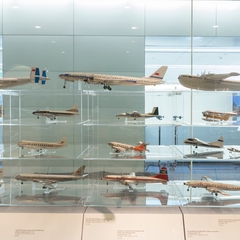
Developed behind the Iron Curtain by the Tupolev Design Bureau during the late 1950s, the massive Tu-114 Rossiya (Russia) turboprop airliner was introduced by the Soviet national airline Aeroflot in 1961.
This image was posted on February 20, 2018.
#aviationevolutions #jimlund #avgeek #avationgeek #aviation #aviationhistory #aviationlovers #vintageaviation #history #avhistory #aviationgeeks #instaplane #flying #modelplane #flight #airline #avgeeks #aviation4u #aviationdaily #modelaircraft #airplane #aircraft
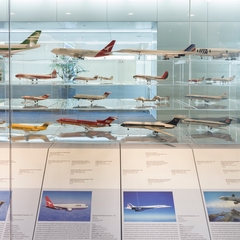
The DC-10 was McDonnell Douglas’ answer to Boeing’s wide-body 747 jumbo-jet.
This image was posted on June 21, 2018.
#aviationevolutions #jimlund #avgeek #avationgeek #aviation #aviationhistory #vintageaviation #history #avhistory #aviationgeeks #modelplane #avgeeks #modelaircraft #airplane #aircraft #dc10
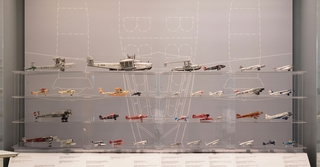
The all-metal, twin-engine Boeing Model 247 was a revolutionary airplane when introduced in 1933.
This image was posted on June 05, 2018.
#jimlund #avgeek #avationgeek #aviation #aviationhistory #vintageaviation #history #avhistory #aviationgeeks #modelplane #avgeeks #modelaircraft #airplane #aircraft
Introduced in 1951, the Lockheed 1049 Super Constellation was an enhanced-range, stretched upgrade of the 049 Constellation and was designed primarily to compete on transatlantic routes with the Douglas DC-6.
This image was posted on October 25, 2018.
#aviationevolutions #jimlund #avgeek #aviationgeek #aviation #aviationhistory #vintageaviation #history #aviationgeeks #modelplane #scalemodel #avgeeks
This post mentions the following things involved with the SFO Museum collection:
Aviation Evolutions: The Jim Lund 1:72 Scale Model Airplane Collection
This aviation exhibition was on display between September 2017 and March 2019 in the AML Aviation Museum Gallery 01 gallery, located in International Terminal