
loading image

In 1957, BOAC (British Overseas Airways Corporation) introduced the long-delayed, turboprop Britannia, developed and produced by the Bristol Aircraft Company of Filton, England. Initially, the fast, large-capacity, long-range airliner was operated on the airline’s London–New York route. Two years later, BOAC inaugurated the its first regular round-the-world service via San Francisco, Hong Kong, and Tokyo. Overall, the Britannia performed well, yet it was plagued with engine intake icing problems. BOAC flew the Britannia for several years before replacing it with faster, more economical, long-range turbojets. Many were later sold to smaller carriers such as Eagle Airways, where the Britannia continued in operation on trans-oceanic routes. During the early 1960s, the airline, then controlled by the Cunard Steamship Company and called Cunard Eagle Airways, offered Britannia transatlantic service first to Bermuda, and shortly after, to New York. In 1965, after reorganizing as British Eagle International Airways, a Britannia inaugurated the airline’s first transatlantic passenger service between South Africa and South America. See "Aviation Evolutions: The Jim Lund 1:72 Scale Model Airplane Collection", which features more than 200 models, on display, pre-security, in the Aviation Museum. http://bit.ly/AviationEvolutions
This image was posted on November 09, 2018.
Similar Instagram posts
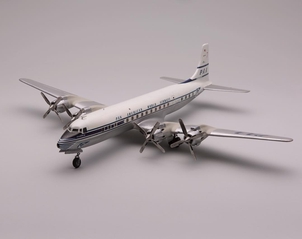
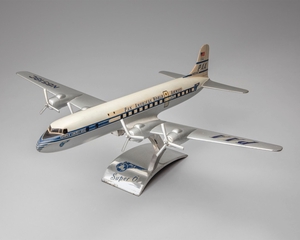
In an effort to compete with TWA (Trans World Airlines) on transatlantic routes to Europe, Pan American World Airways ordered the extended-range DC-7C (dubbed the “Seven Seas”) from Douglas Aircraft.
This image was posted on September 13, 2018.
#aviationevolutions #jimlund #avgeek #aviationgeek #aviation
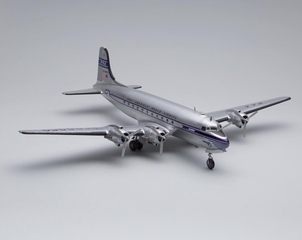
During the late 1930s, following a request from United Air Lines, Douglas Aircraft of Santa Monica, California, developed a large-capacity, long-range, pressurized, four-engine airliner.
This image was posted on December 26, 2018.
#aviationevolutions #modelplane #scalemodel #avgeek #aviationhistory #dc-4 #panam
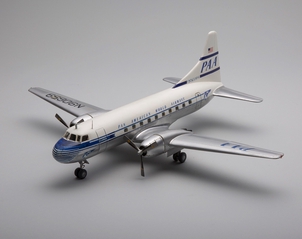
The Convair 240 was the first postwar commercial airliner developed by the Consolidated Vultee Company, or Convair, of San Diego.
This image was posted on July 18, 2018.
#aviationevolutions #jimlund #avgeek #avationgeek #aviation #aviationhistory #vintageaviation #history #avhistory #aviationgeeks #modelplane #avgeeks #modelaircraft #airplane #aircraft #convair #convair240
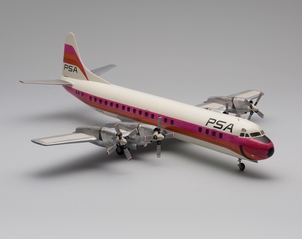
The Lockheed L-188 Electra was the only large turboprop airliner produced in the United States.
This image was posted on July 11, 2018.
#aviationevolutions #jimlund #avgeek #avationgeek #aviation #aviationhistory #vintageaviation #history #avhistory #aviationgeeks #modelplane #avgeeks #modelaircraft #airplane #aircraft
Have you visited our new aviation collections website?
This image was posted on February 09, 2022.
#museumlife #avgeek
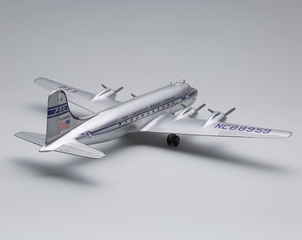
During the late 1930s, following a request from United Air Lines, Douglas Aircraft of Santa Monica, California, developed a large-capacity, long-range, pressurized, four-engine airliner.
This image was posted on December 26, 2018.
#aviationevolutions #modelplane #scalemodel #avgeek #aviationhistory #dc-4 #panam
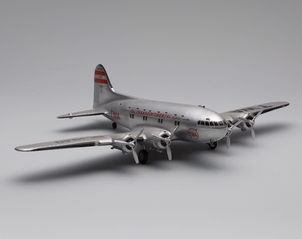
The Boeing 307 Stratoliner was the first commercial airliner put in service to have a pressurized cabin.
This image was posted on July 05, 2018.
#aviationevolutions #jimlund #avgeek #avationgeek #aviation #aviationhistory #vintageaviation #history #avhistory #aviationgeeks #modelplane #avgeeks #modelaircraft #airplane #aircraft #boeing #boeing307 #twa
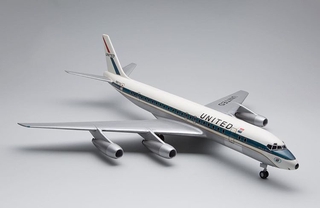
The Douglas DC-8 was developed during the mid-1950s as a competitive design to Boeing’s 707.
This image was posted on January 09, 2019.
#aviationevolutions #jimlund #avgeek #aviationgeek #aviation #aviationhistory #vintageaviation #history #aviationgeeks #modelplane #scalemodel #avgeeks
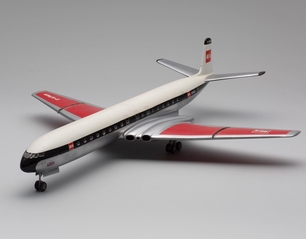
Introduced in 1952, the de Havilland D.H. 106 Comet was the first commercial passenger jetliner to enter service, years before the introduction of other jetliners.
This image was posted on June 16, 2021.
#wingwednesday #avgeek #airplane #dehavilland #dehavillandcomet #jet
This post mentions the following things involved with the SFO Museum collection:
Aviation Evolutions: The Jim Lund 1:72 Scale Model Airplane Collection
This aviation exhibition was on display between September 2017 and March 2019 in the AML Aviation Museum Gallery 01 gallery, located in International Terminal