
loading image

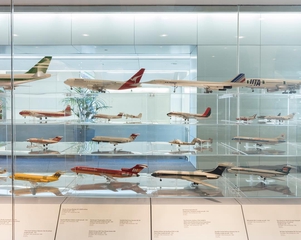
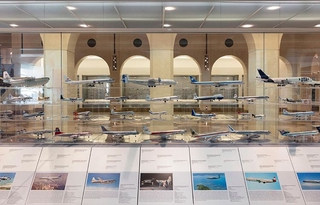
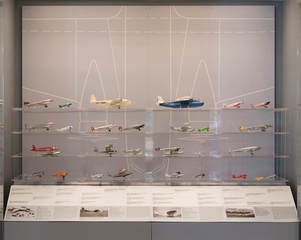
The Boeing 727 was a medium range, intermediate-capacity jetliner that could serve regional airports with short runways. It featured a clean swept wing, a high horizontal stabilizer, and a unique tri-jet configuration, which was influenced by the Hawker Siddeley Trident. The only tri-jet to be developed by Boeing, the 727 was equipped with three Pratt & Whitney JT8D-7 turbofan engines mounted in a triangular configuration at the tail-end of the aircraft—two attached with extended mounts and the middle mounted within the vertical stabilizer. This design dictated that the horizontal stabilizer be placed well away from the middle engine, high on top of the vertical stabilizer. At the aft underbelly was a uniquely located passenger door and air stair that allowed passengers to exit from the back of the aircraft. Braniff International Airways purchased a large fleet of the 727 and, after advertising executive Mary Wells radically revamped the airline’s corporate identity, painted their aircraft in a variety of brightly colored liveries. See "Aviation Evolutions: The Jim Lund 1:72 Scale Model Airplane Collection", which features more than 200 models, on display, pre-security, in the Aviation Museum. http://bit.ly/AviationEvolutions
This image was posted on January 04, 2019.
Similar Instagram posts
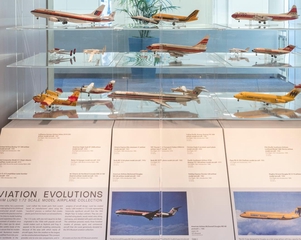
The McDonnell Douglas MD-80 was an updated version of the DC-9, which was introduced in 1965.
This image was posted on December 11, 2018.
#aviationevolutions #jimlund #mcdonnelldouglas #md80 #americanair #avgeek #aviationgeek #aviation #aviationhistory #vintageaviation #history #aviationgeeks #modelplane #scalemodel #avgeeks
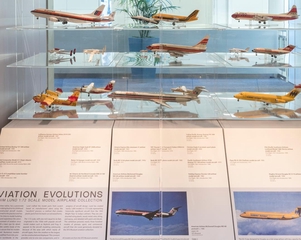
The McDonnell Douglas MD-80 was an updated version of the DC-9, which was introduced in 1965.
This image was posted on December 11, 2018.
#aviationevolutions #jimlund #mcdonnelldouglas #md80 #americanair #avgeek #aviationgeek #aviation #aviationhistory #vintageaviation #history #aviationgeeks #modelplane #scalemodel #avgeeks
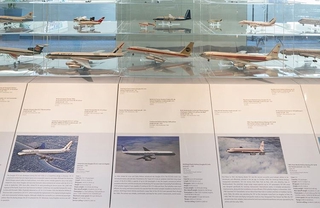
The Douglas DC-8 was developed during the mid-1950s as a competitive design to Boeing’s 707.
This image was posted on January 09, 2019.
#aviationevolutions #jimlund #avgeek #aviationgeek #aviation #aviationhistory #vintageaviation #history #aviationgeeks #modelplane #scalemodel #avgeeks
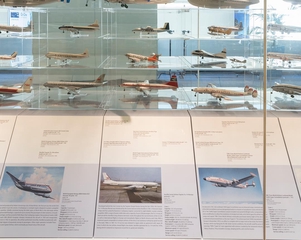
Introduced in 1951, the Lockheed 1049 Super Constellation was an enhanced-range, stretched upgrade of the 049 Constellation and was designed primarily to compete on transatlantic routes with the Douglas DC-6.
This image was posted on October 25, 2018.
#aviationevolutions #jimlund #avgeek #aviationgeek #aviation #aviationhistory #vintageaviation #history #aviationgeeks #modelplane #scalemodel #avgeeks
The DC-10 was McDonnell Douglas’ first wide-body jetliner.
This image was posted on October 12, 2018.
#aviationevolutions #jimlund #avgeek #aviationgeek #aviation #aviationhistory #vintageaviation #history #aviationgeeks #modelplane #scalemodel #avgeeks
In 1957, BOAC (British Overseas Airways Corporation) introduced the long-delayed, turboprop Britannia, developed and produced by the Bristol Aircraft Company of Filton, England.
This image was posted on November 09, 2018.
#aviationevolutions #jimlund #avgeek #aviationgeek #aviation #aviationhistory #vintageaviation #history #aviationgeeks #modelplane #scalemodel #avgeeks #boac #britannia #england #britishoverseasairwayscorporation
The DC-10 was McDonnell Douglas’ answer to Boeing’s wide-body 747 jumbo-jet.
This image was posted on June 21, 2018.
#aviationevolutions #jimlund #avgeek #avationgeek #aviation #aviationhistory #vintageaviation #history #avhistory #aviationgeeks #modelplane #avgeeks #modelaircraft #airplane #aircraft #dc10
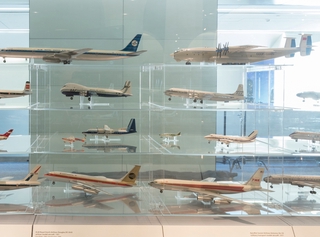
First flown in 1957, the Boeing Model 707 was the first US-made, pure-turbojet airliner to be introduced.
This image was posted on January 24, 2018.
#aviationevolutions #jimlund #avgeek #avationgeek #aviation #aviationhistory #aviationlovers #vintageaviation #history #avhistory #aviationgeeks #flying #modelplane #avgeeks #modelaircraft #airplane #aircraft #boeing #boeing707 #twa
The Douglas DC-3 was arguably the most significant commercial airliner introduced before World War II.
This image was posted on February 07, 2019.
#aviationevolutions #jimlund #avgeek #aviationgeek #aviation #aviationhistory #vintageaviation #history #aviationgeeks #modelplane #scalemodel #avgeeks
This post mentions the following things involved with the SFO Museum collection:
Aviation Evolutions: The Jim Lund 1:72 Scale Model Airplane Collection
This aviation exhibition was on display between September 2017 and March 2019 in the AML Aviation Museum Gallery 01 gallery, located in International Terminal