
@SFOMuseum Twitter Posts Tagged IntriguingInsects This is SFO Museum's archive of the @SFOMuseum Twitter account. There are 69 posts and this is page 5 of 6. See all the tags or all the Twitter posts that have been archived so far.
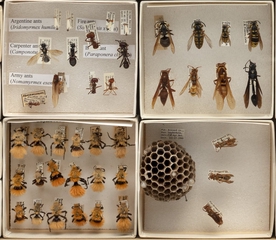
When foraging among flowers, bees accidentally drop pollen, which pollinates the plant. Nearly 4,400 different species of bees inhabit North America, and more than 20,000 species of bees exist worldwide. #IntriguingInsects
This tweet was posted on June 20, 2019.
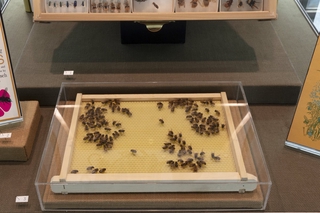
Bees, wasps, and ants live in societies with overlapping generations and complex visual and chemical communication systems. For example, honey bees do a “waggle dance” to communicate the distance, direction, and quality of nectar and pollen resources. #IntriguingInsects
This tweet was posted on June 20, 2019.
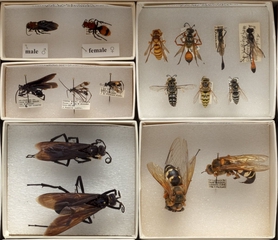
Bees, wasps, and ants all belong to the order Hymenoptera, meaning membranous wings. Most conspicuous and well-known are social species, including honey bees, yellowjacket wasps, and ants. #IntriguingInsects
This tweet was posted on June 20, 2019.
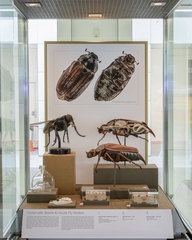
See “The Intriguing World of Insects” on display, pre-security, in the International Terminal. https://t.co/McPBuOIH0Z #IntriguingInsects
This tweet was posted on June 13, 2019.
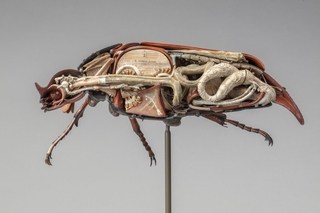
This papier-mâché model of a cockchafer beetle was made for French surgeon Dr. Louis Auzoux in 1881 as a teaching tool for #entomology students. All of the internal and external organs are labeled with their proper names. #IntriguingInsects
This tweet was posted on June 13, 2019.
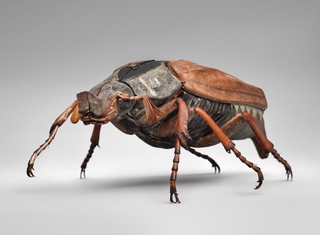
The cockchafer beetle (Melolontha melolontha Linnaeus, 1758) is a well-known plant pest in Europe, and one of the first beetle species named by Carl von Linné (a.k.a. Linnaeus), the Swedish biologist who created the binomial system for naming species. #IntriguingInsects
This tweet was posted on June 13, 2019.
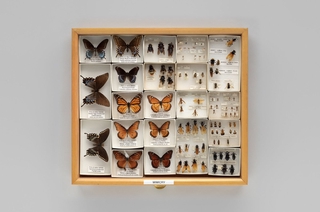
See “The Intriguing World of Insects” on display, pre-security, in the International Terminal. https://t.co/McPBuOIH0Z #IntriguingInsects
This tweet was posted on June 06, 2019.
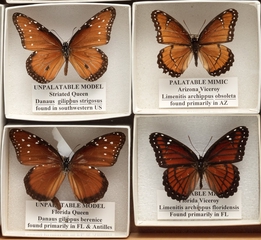
Batesian mimicry on the other hand is used by some insects that are palatable but have evolved color patterns similar to the noxious species. #IntriguingInsects
This tweet was posted on June 06, 2019.
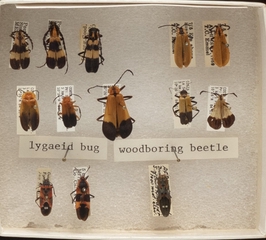
Insects with bright, high-contrast colors evolved these color patterns to repel predators. The evolution of these color patterns by noxious insects is called Müllerian mimicry. #IntriguingInsects
This tweet was posted on June 06, 2019.

See “The Intriguing World of Insects” on display, pre-security, in the International Terminal. https://t.co/McPBuP0ipz #IntriguingInsects #GarWaterman
This tweet was posted on May 31, 2019.
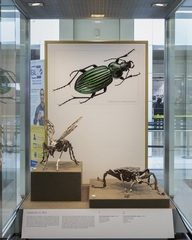
However, insects could never grow to the size of this sculpture. They would suffocate for lack of oxygen and probably collapse under the weight of their own exoskeletons, which would have to be much thicker and heavier to maintain their shape. #IntriguingInsects
This tweet was posted on May 31, 2019.
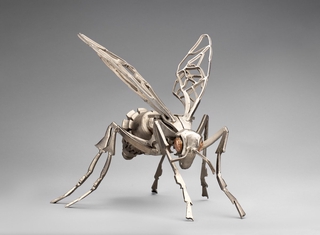
Artist Gar Waterman brings the magnificence of the wasp to life with this sculpture. Its long legs and steel construction illustrates the insect’s agility and strength. #IntriguingInsects #GarWaterman
This tweet was posted on May 31, 2019.