
Search results for @Boeing
that are a tweet
See all the search results for this query
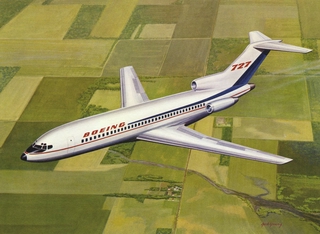
The Boeing 727 was a medium range, intermediate-capacity jetliner that could serve regional airports with short runways. It featured a clean swept wing, a high horizontal stabilizer, and a unique tri-jet configuration. #WingWednesday
This tweet was posted on July 21, 2021.
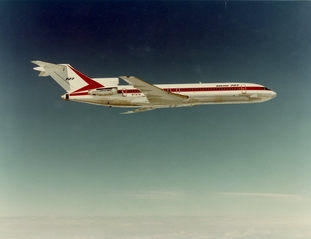
The only tri-jet developed by Boeing, the 727 was equipped with 3 Pratt & Whitney JT8D-7 turbofan engines mounted in a triangular configuration at the tail-end of the aircraft—two attached with extended mounts and the middle mounted within the vertical stabilizer. #WingWednesday
This tweet was posted on July 21, 2021.
📸 1/4:
photograph: Boeing 727-100; c. 1963
Robert W. Jackson
2006.002.092
poster: Boeing 727; 1980s
Gift of Walton F. Kemmerle
2008.007.003
photograph: Boeing 727-200; c. 1975
Gift of the William Hough Collection
2012.096.161
This tweet was posted on July 21, 2021.
📸 2/4:
postcard: Boeing 727; 1963
Gift of the Captain John B. Russell Family
2012.149.0603
photograph: San Francisco International Airport (SFO), Pacific Southwest Airlines (PSA) Boeing 727; 1968
Transfer
2011.068.008.001
This tweet was posted on July 21, 2021.
📸 4/4:
photograph: Braniff International Airways, Boeing 727-200, Dallas-Fort Worth International Airport (DFW); 1970s
Gift of William Rys, Jr.
2019.085.135
postcard: Braniff International Airways, Boeing 727-200; c. 1970
Gift of the William Hough Collection
2008.055.213
This tweet was posted on July 21, 2021.
RT @airandspace: On this day in 1940, the first pressurized cabin airliner, the Boeing 307 Stratoliner, went into service with TWA. The las…
This tweet was posted on July 08, 2021.
RT @airandspace: Today in 1954, the Boeing 367-80, aka the Dash 80, made its first flight. The Dash 80 was the prototype of America's first…
This tweet was posted on July 15, 2021.
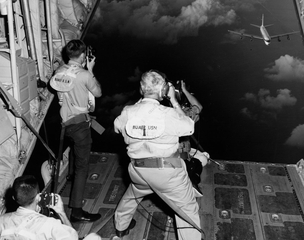
In September 1959, the DC-8 entered service with Delta and United, nearly a year after the introduction of the Boeing 707. Although initially not as successful as the 707, the DC-8 had a more viable lifespan within the commercial aviation industry. #WingWednesday
This tweet was posted on July 07, 2021.
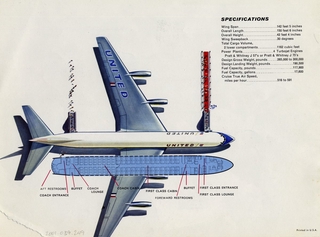
It comprised a swept-wing, four-jet-engine layout similar to that of the Boeing 707 with a capacity for up to 179 passengers. Powered by four Pratt & Whitney J57 turbojet engines, the DC-8 was capable of cruising speeds reaching 600 miles per hour. #WingWednesday
This tweet was posted on July 07, 2021.
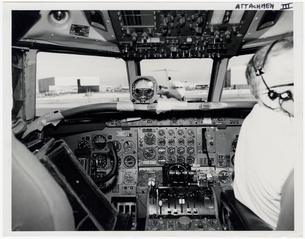
Upgraded variants were introduced during the 1960s, including a stretched version that was the largest capacity airliner until the introduction of the widebody Boeing 747 in 1970. #WingWednesday
This tweet was posted on July 07, 2021.
📸 2/3:
All: photographs, Boeing 707
Pan Am; c. 1959
Gift of M.D. Klaas
2018.112.0776 a b
Continental; c. 1960
Gift of M.D. Klaas
2018.112.0138
Pan Am, 707-121; c.1958
Gift of M.D. Klaas
2018.112.0762
TWA, 707-300C; c. 1975
Gift of the William Hough Collection
2012.167.035
This tweet was posted on June 23, 2021.
📸 1/3:
All: Pan American World Airways, Boeing 707
photo: at Renton, Washington; 1958
Gift of Thomas G. Dragges
2015.165.202
photo; 1958
Gift of Thomas G. Dragges
2015.165.203
postcard: first scheduled service to Paris; Oct. 26, 1958
Gift of Ernest J. Colant
1993.17.08
This tweet was posted on June 23, 2021.
📸 3/3:
All: Boeing 707
photo: China Airlines, 707-320C, LAX; 1971
Gift of the Family of Carl Chi-hsun Ma
2017.023.013
postcard: Saudi Arabian Airlines, 707; c. 1975
Gift of George Gayuski
2001.082.220
photo: Pan Am, 707-121 lounge; c. 1958
Gift of M.D. Klaas
2018.112.0768
This tweet was posted on June 23, 2021.
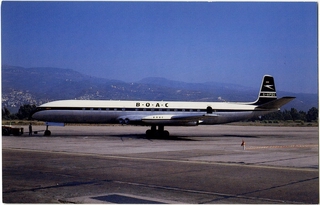
BEA inaugurated shorter-range Comet Mk. 4B service on its Tel Aviv-London route in April 1960. The Comet Mk. 4 had a cruising speed of just over 500mph and accommodated up to 81 passengers, but ultimately could not compete with the Boeing 707 or the Douglas DC-8. #WingWednesday
This tweet was posted on June 16, 2021.
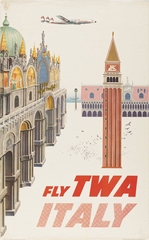
Forty-four L-1649 Starliners were produced and by the early 1960s, with the end of the propliner era, they were replaced by the much faster Boeing 707 jetliner. #WingWednesday
This tweet was posted on June 09, 2021.
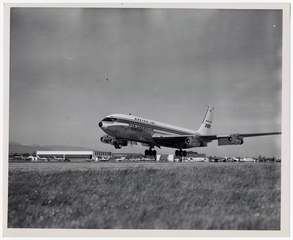
The Boeing 707 was originally developed following an initial request in 1955 from Pan American World Airways for a large capacity jet-powered airliner. #WingWednesday
This tweet was posted on June 23, 2021.
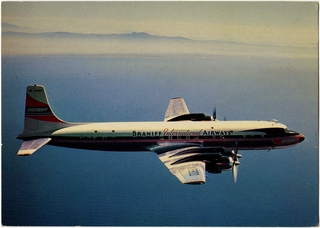
In 1957, Braniff International Airways launched DC-7C service to South America that it dubbed “El Dorado” service. Sales of the DC-7 rapidly declined by the end of the decade, with the arrival of long-range jets such as the Boeing 707 and Douglas DC-8. #WingWednesday
This tweet was posted on June 02, 2021.
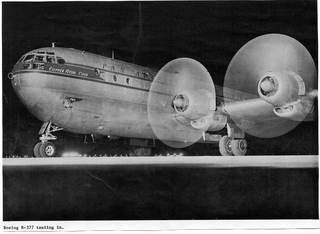
The Boeing 377 Stratocruiser was considered the most luxurious airliner aloft when introduced by Pan American World Airways in 1949. #WingWednesday
This tweet was posted on May 12, 2021.
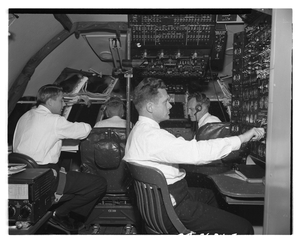
With nineteen windowpanes, the cockpit of the Boeing 377 offered one of the highest degrees of visibility of any airliner. #WingWednesday
This tweet was posted on May 12, 2021.
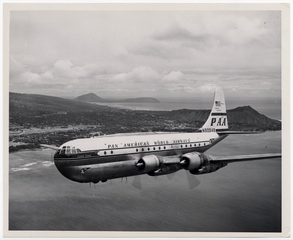
#PanAm launched Boeing 377 Stratocruiser service from San Francisco to Hawai’i in April 1949, and transatlantic service to London in June 1949 as all first-class “President” service. #WingWednesday
This tweet was posted on May 12, 2021.
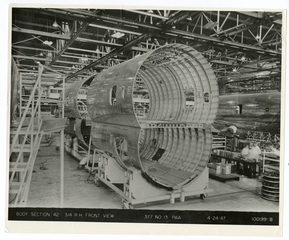
The Boeing 377's unique, pressurized, “double-bubble” fuselage was equipped with two decks: the upper contained a roomy main cabin, while the lower featured the highly popular cocktail lounge. #WingWednesday
This tweet was posted on May 12, 2021.
📸 1/3:
All: Pan Am, Boeing 377
c. 1950
Gift of the Pan Am Association
2000.058.0460
Over San Francisco; 1949
Gift of Vernon W. Smith
1999.562.005
In factory; 1947
Gift of the Captain John B. Russell Family
2012.149.1485
Ad; 1948
Gift of Barnaby Conrad III
2001.038.164.036
This tweet was posted on May 12, 2021.
📸 2/3:
All are Pan Am Boeing 377s
Lounge; c. 1952
Gift of William E. Talbott
2012.151.310
Cockpit; c. 1952
Gift of William E. Talbott
2012.151.312
Cockpit simulator; c. 1949
Gift of the San Francisco Aeronautical Society
2002.017.006.004
This tweet was posted on May 12, 2021.
📸 3/3:
Pan Am, Pacific route map; 1949
Gift of the Pan Am Association
2000.058.0460.013
Pan Am, Boeing 377 over Diamond Head; c. 1949
Gift of M.D. Klaas
2018.112.0694
United, Boeing 377; christening of the Waipahu; Jan. 14, 1950
Gift of M.D. Klaas
2018.112.0922
This tweet was posted on May 12, 2021.
📸2:
Aerovias Venezuela Europa, DC-4 cockpit; 1950s
Gift of Thomas G. Dragges
2015.166.0108
Pan Am, Boeing 314a “Capetown Clipper” and Douglas DC-4; c. late 1940s
1993.03.14
Pan Am, DC-4; late 1940s
1993.03.22
Western Air Lines; Nov. 1949
Gift of Thomas G. Dragges
2015.167.887
This tweet was posted on April 07, 2021.
📸:
Transcontinental & Western Air (TWA); c. 1940
Purchase
1996.35.056
Pan American Airways; c. 1940
Gift of Elsa Cameron
1997.54.04.01
United Air Lines; c. 1935
Gift of United Airlines Archives
1999.047.558
Boeing System; c. 1930
Gift of United Airlines Archives
1999.047.561
This tweet was posted on April 13, 2021.
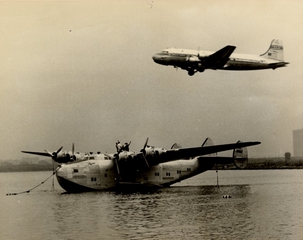
By late 1945, #PanAm realized the superiority of the DC-4 over the Boeing 314 flying boat and began to operate the airliner on both transpacific and transatlantic routes. #WingWednesday #avgeek
This tweet was posted on April 07, 2021.
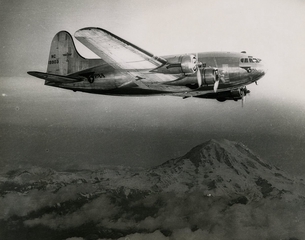
In 1934, Boeing began design studies for a four-engine bomber in conjunction with a four-engine civil airliner. The bomber version became the B-17 and was produced in large numbers. The civil airliner version emerged as the Model 307. #WingWednesday
This tweet was posted on March 31, 2021.
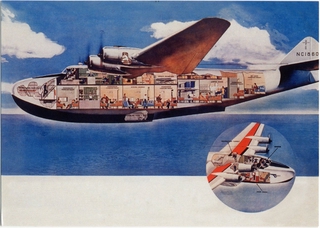
The largest and most luxurious of all of the flying boats, the Boeing 314 was called a flying hotel by journalists of the day. #WingWednesday #avgeek
This tweet was posted on March 17, 2021.
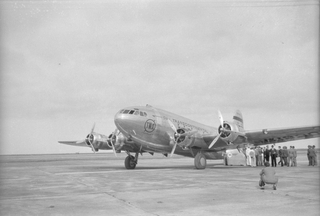
These days, it's common for planes to cruise at altitudes of 35,000 feet. But back in 1940, when the first pressurized commercial airliner, the Boeing 307 Stratoliner, was introduced, it was a marvel to fly above most weather disturbances at 20,000 feet. #WingWednesday
This tweet was posted on March 31, 2021.
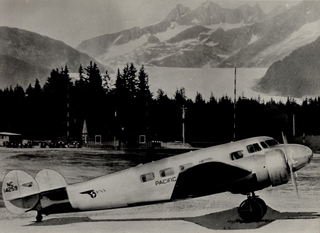
The Lockheed Model 10 Electra was introduced in 1935 as the manufacturer's first all-metal aircraft, developed to compete with the Douglas DC-2 and Boeing 247. #WingWednesday #avgeek
This tweet was posted on February 24, 2021.
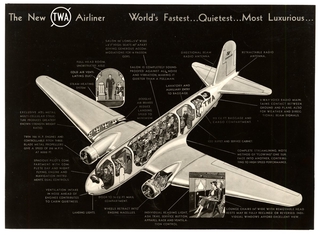
As rival United Air Lines had exclusive rights to the Boeing 247, TWA (Transcontinental & Western Air) turned to Douglas Aircraft to develop an improved competitor. The Douglas DC-2 was developed in the early 1930s and introduced in 1934. #WingWednesday #avgeek
This tweet was posted on February 10, 2021.
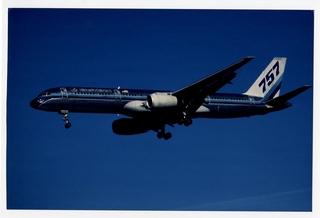
#OTD in 1982, the Boeing 757 took its first flight. Designed to be more fuel efficient than its predecessor, the trijet 727, the twinjet 757 was used by airlines around the world on short- to medium-range flights. Over 1,000 of the aircraft were built. #AvGeek
This tweet was posted on February 19, 2021.
📸:
photograph: Eastern Airlines, Boeing 757, 1980s
Gift of William Rys, Jr.
2019.085.156
postcard: Condor, Boeing 757-200, 1980s
Gift of Thomas G. Dragges
2915.166.0481
postcard: LTE International Airways, Boeing 757-200, 1980s
Gift of Thomas G. Dragges
2015.166.0961
This tweet was posted on February 19, 2021.
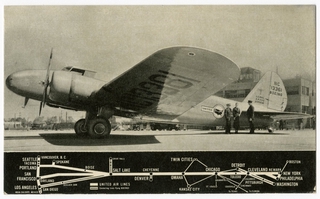
Seventy-five of the Boeing 247 were built, with most going to United Air Lines’ fleet and operating on its "Mainline" transcontinental route. #WingWednesday #avgeek
This tweet was posted on February 03, 2021.
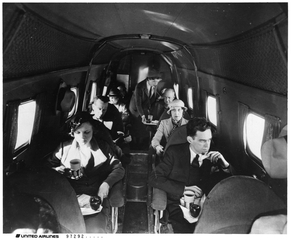
Advanced for its time, the Boeing 247 accommodated only ten passengers, which made it less economical to operate than larger capacity airliners, particularly the more fuel-efficient, fourteen-seat Douglas DC-2, introduced a year later in 1934. #WingWednesday #avgeek
This tweet was posted on February 03, 2021.