
Search results for airline
Refine these results
📸 3/3:
All: United
DC-8; 1962
Gift of United Airlines Archives
2005.015.028
DC-8 lounge; c. 1959
Gift of M.D. Klaas
2018.112.0932
DC-8 cockpit; 1960s
Gift of Thomas G. Dragges
2015.109.103
brochure: DC-8-61; c. 1967
Gift of the William Hough Collection
2012.096.188
This tweet was posted on July 07, 2021.
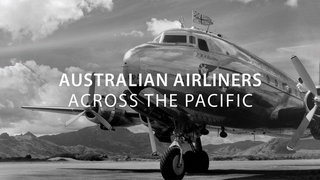
"Australian Airliners Across the Pacific" illustrates the evolution of the aircraft utilized and passenger service implemented by Australian airline companies in their post-World War II transpacific services. https://t.co/3AWJNlEKRV
This tweet was posted on July 13, 2021.
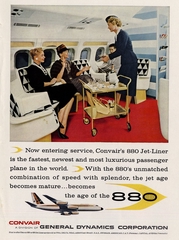
In 1960, Delta Airlines proudly introduced the 615 miles-per-hour Convair 880, produced by the Convair Division of General Dynamics, of San Diego, California. In January 1962, the airliner achieved a record top speed of 715 mph on a flight from Chicago to Miami. #WingWednesday
This tweet was posted on July 14, 2021.
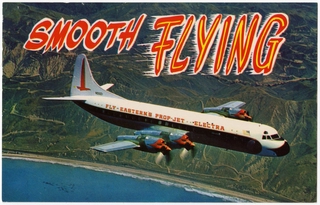
Eastern was the first to inaugurate service of the Lockheed L-188 Electra in January 1959. The regional airline PSA (Pacific Southwest Airlines), based in San Diego, purchased three of the aircraft, which proved ideal for the carrier’s West Coast routes. #WingWednesday
This tweet was posted on June 30, 2021.
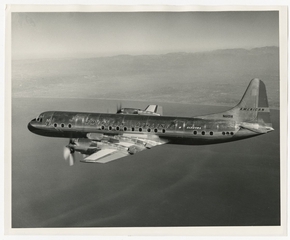
The Lockheed L-188 Electra featured a relatively short-span, low-mounted, cantilevered wing with four Allison turboprop engines. The prototype flew in 1957, and the next year, initial deliveries went to American and Eastern Airlines. #WingWednesday
This tweet was posted on June 30, 2021.
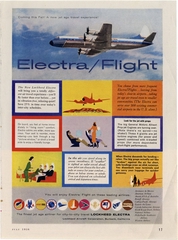
The Lockheed L-188 Electra was the only large turboprop airliner produced in the United States. The design originated in the mid-1950s with a request from American Airlines for a fast, mid-range, high-capacity airliner. #WingWednesday
This tweet was posted on June 30, 2021.
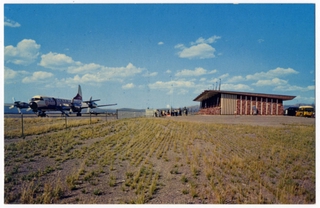
With the introduction of faster mid-range turbojets, the L-188 Electra was primarily relegated to regional airlines and cargo carriers. One of its more recent uses is as a large capacity air tanker used in the control of wildfires. #WingWednesday
This tweet was posted on June 30, 2021.
📸 1/3:
ad: L-188 Electra ; 1958
Purchase
2012.118.001
model airplane: Western Airlines, L-188-A Electra;
Gift of the San Francisco Aeronautical Society
2018.127.005 a f
photo: American Airlines, L-188 Electra; c. 1958
Gift of Thomas G. Dragges
2015.165.060
This tweet was posted on June 30, 2021.
📸 3/3:
postcard: West Yellowstone Airport, Western Airlines, L-188 Electra; 1960s
Gift of Thomas G. Dragges
2015.166.2421
postcard: Transamerica Airlines, L-188CF Electra; 1980s
Gift of George Gayuski
2001.082.153
This tweet was posted on June 30, 2021.
📸 1/2:
Chicago & Southern Air Lines (C&S); 1950s
Gift of Thomas G. Dragges
2012.065.180
California Central Airlines; c. 1953
Gift of Thomas G. Dragges
2012.065.147
Pan American World Airways; 1950s
Gift of Barnaby Conrad III
2001.038.028
This tweet was posted on July 02, 2021.
📸 2/3:
all: L-188 Electra
photo: American Airlines; c. 1958
Gift of Thomas G. Dragges
2015.165.061
postcard: Eastern Air Lines; c. 1959
Gift of David Armstrong Abercrombie
2015.037.129
slide: PSA; late 1970s
Gift of Daniel Hahn
2015.038.072
This tweet was posted on June 30, 2021.
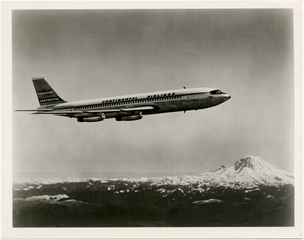
As a result of its reliability, capacity, and considerably reduced seat-mile cost, the 707 proved to be the world's first viable commercial jetliner with regular and sustained scheduled service, and revolutionized the airline industry by ushering in the jet age. #WingWednesday
This tweet was posted on June 23, 2021.
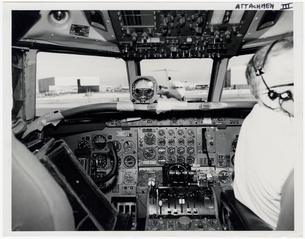
Upgraded variants were introduced during the 1960s, including a stretched version that was the largest capacity airliner until the introduction of the widebody Boeing 747 in 1970. #WingWednesday
This tweet was posted on July 07, 2021.
📸 3/3:
All: Boeing 707
photo: China Airlines, 707-320C, LAX; 1971
Gift of the Family of Carl Chi-hsun Ma
2017.023.013
postcard: Saudi Arabian Airlines, 707; c. 1975
Gift of George Gayuski
2001.082.220
photo: Pan Am, 707-121 lounge; c. 1958
Gift of M.D. Klaas
2018.112.0768
This tweet was posted on June 23, 2021.
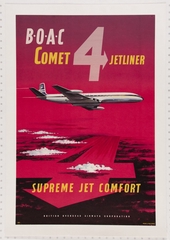
After many years of redesigning, the much-improved, lengthened, D.H. 106 Comet Mk. 4 was delivered to BOAC in 1958. Shortly after, the airline inaugurated regular transatlantic jet service from London to New York with one refueling stop in Newfoundland. #WingWednesday
This tweet was posted on June 16, 2021.
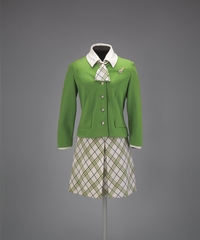
Trans World Airlines (TWA) took a subtle approach to their 1968 summer uniform. Designed by Dalton Apparel, it featured a short-sleeve, ivory dress with a lime green, brown, and navy, plaid-patterned skirt and necktie, along with a matching vinyl belt. #FlightPatterns
This tweet was posted on June 29, 2021.
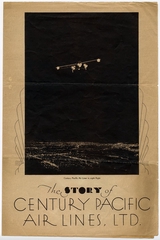
Century Pacific Air Lines was one of the early commercial airline companies to operate at Mills Field. In May of 1931, the company announced it would start service on the West Coast, and San Francisco was selected as its main base of operations.
This tweet was posted on June 22, 2021.
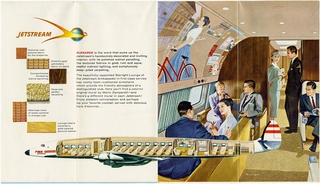
Named the “Jetstream” by TWA (Trans World Airlines), the L-1649 Starliner had a 100-passenger capacity and could cruise at a speed of 300 mph. Lufthansa and Air France were the only carriers besides TWA to operate it on the transatlantic route. #WingWednesday
This tweet was posted on June 09, 2021.
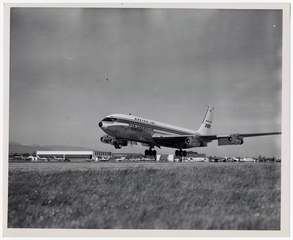
The Boeing 707 was originally developed following an initial request in 1955 from Pan American World Airways for a large capacity jet-powered airliner. #WingWednesday
This tweet was posted on June 23, 2021.
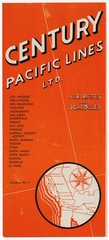
The airline was a major tenant for Mills Field, carrying just over 10,000 passengers along its routes between June and September of 1931.
(Check out those one-way airfares!)
This tweet was posted on June 22, 2021.
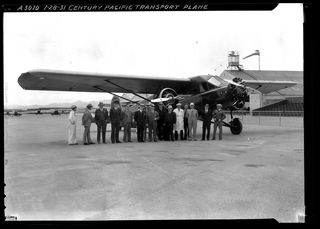
The airline, though, was short lived - it was taken over by American Airways (later American Airlines) in April 1932 and ceased operations in San Francisco the following month.
This tweet was posted on June 22, 2021.
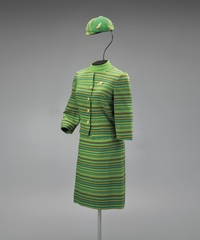
Mid-1960s airline fashion showcased bright and colorful, patterned fabrics for the first time in the industry. In 1967, Starflite Uniforms created an ensemble patterned in bold stripes for Northwest Orient Airlines. #FlightPatterns
This tweet was posted on June 10, 2021.
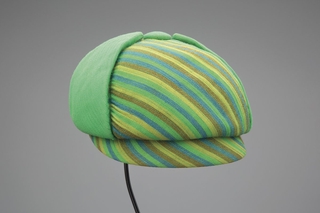
Worn as a summer uniform until 1971, it was nicknamed “The Caterpillar” by Northwest Orient Airlines flight crew and included a striped trapper hat with green side flaps. #FlightPatterns
This tweet was posted on June 10, 2021.
📸:
Northwest Orient Airlines uniform 1967
Starflite Uniforms
Hat by Mae Hanauer
Dress: Gift of The Museum of Flight
Hat: Gift of Northwest Airlines History Center
Jacket insignia: Gift of the Captain John B. Russell Family
Hat insignia: Gift of Matthew Blakley
This tweet was posted on June 10, 2021.
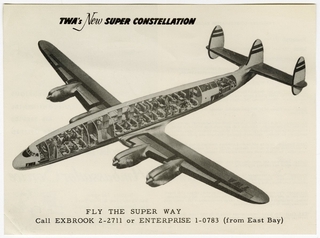
The L-1049's cabin was divided into multiple sections to minimize the effect of the long-tube view when looking up from one's seat. With a 100-passenger capacity, the airliner had a range of 4,000 miles and a cruising speed of 300 miles. #WingWednesday
This tweet was posted on May 26, 2021.
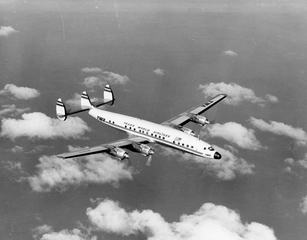
The L-1649 Starliner, the final variant in Lockheed’s Constellation-based design series, embodied the zenith in large-capacity, piston-engine airliner development, rivaled only by the Douglas DC-7C, with which it was designed to compete. #WingWednesday #avgeek
This tweet was posted on June 09, 2021.
📸:
All: @flySFO
Most: Transfers
construction; 1952
2011.032.0292
aerial view; May 19, 1954
1997.52.045.011
United Air Lines, Douglas DC-7; late 1950s
Gift of United Airlines Archives
1999.047.254
aerial view; May 1954
2011.032.0393
interior; 1962
2011.032.0770
This tweet was posted on May 25, 2021.
Not one, but TWO exhibitions and galleries opened this week! #FlightPatterns, looks at how social change affected airline uniforms in the 1960s-70s, and #StonewareStories examines the unique folk pottery produced in Edgefield, South Carolina, in the 19th and early 20th centuries.
This tweet was posted on May 28, 2021.
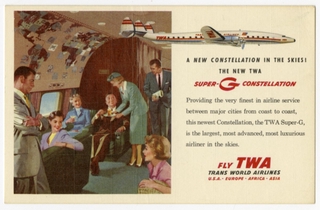
The L-1049G Super Constellation variant, introduced into service in 1955 by TWA (Trans World Airways) and Northwest Orient Airlines, was the ultra long-range version of the aircraft. #WingWednesday
This tweet was posted on May 26, 2021.
📸 1/3:
TWA, L-1049 at SFO; c. 1954
Transfer
1993.07.41
Northwest Airlines, L-1049; early 1950s
Gift of M.D. Klaas
2018.112.0248
TWA, L-1049; 1950s
Gift of Thomas G. Dragges
2015.165.890
ad: L-1049; 1951
Purchase
2011.171.001
This tweet was posted on May 26, 2021.
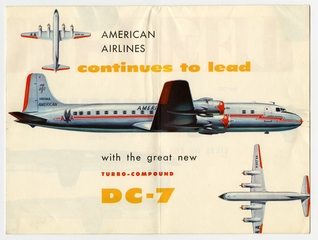
The DC-7 was Douglas Aircraft’s last design evolution of the piston-powered, four-engine, low-wing airliner layout that began with the DC-4. In 1953, American Airlines introduced the DC-7 as its first nonstop, transcontinental airliner. #WingWednesday
This tweet was posted on June 02, 2021.
📸 1/3:
American, DC-7; 1953
Gift of M.D. Klaas
2018.112.1186
American, DC-7B, SFO; 1958
Gift of William T. Larkins
2004.051.003
United, DC-7; c. 1956
Gift of United Airlines Archives
2000.150.006
Airmail flight cover; June 1, 1954
Gift of Capt. Jon Simmonds
2014.156.214 a b
This tweet was posted on June 02, 2021.
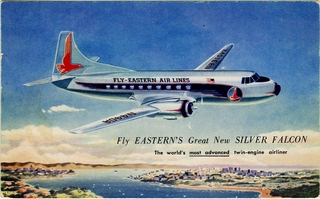
Eastern Air Lines ordered sixty of the 4-0-4 and introduced the aircraft in 1951, with scheduled service commencing in early 1952. The airline operated the 4-0-4 primarily on its eastern U.S. routes and branded the service as the “Silver Falcon.” #WingWednesday
This tweet was posted on May 19, 2021.
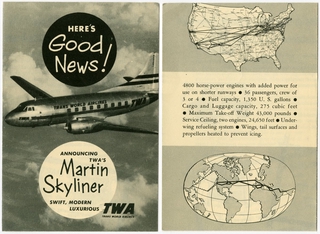
TWA (Trans World Airlines) was the only other major carrier to order the Martin 4-0-4, and operated a fleet of forty. Other airlines operating the 4-0-4 included Southern Airways and Piedmont Airlines. #WingWednesday
This tweet was posted on May 19, 2021.
📸 2/2
All: Martin 4-0-4
TWA; c. 1950
Gift of Thomas G. Dragges
2015.165.885
Southern Airways over Atlanta; 1960s
Gift of Thomas G. Dragges
2015.166.1350
Piedmont Airlines, Atlanta Airport; 1960s
Gift of Thomas G. Dragges
2015.166.1790
This tweet was posted on May 19, 2021.
📸:
Trans World Airlines uniform; 1965
Pierre Balmain
Hat by Mae Hanauer
Gift of TWA Clipped Wings International, Inc.
2002.113.054
Cathay Pacific Airways uniform; 1974
Pierre Balmain
Gift of Cathay Pacific Airways
2009.060.028-.033
This tweet was posted on May 18, 2021.