
Search results for airline
that are a tweet
See all the search results for this query
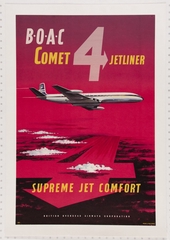
After many years of redesigning, the much-improved, lengthened, D.H. 106 Comet Mk. 4 was delivered to BOAC in 1958. Shortly after, the airline inaugurated regular transatlantic jet service from London to New York with one refueling stop in Newfoundland. #WingWednesday
This tweet was posted on June 16, 2021.
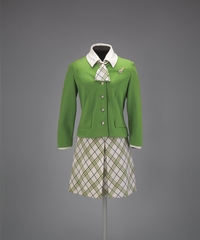
Trans World Airlines (TWA) took a subtle approach to their 1968 summer uniform. Designed by Dalton Apparel, it featured a short-sleeve, ivory dress with a lime green, brown, and navy, plaid-patterned skirt and necktie, along with a matching vinyl belt. #FlightPatterns
This tweet was posted on June 29, 2021.
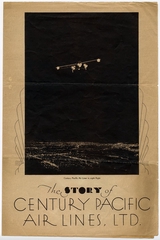
Century Pacific Air Lines was one of the early commercial airline companies to operate at Mills Field. In May of 1931, the company announced it would start service on the West Coast, and San Francisco was selected as its main base of operations.
This tweet was posted on June 22, 2021.
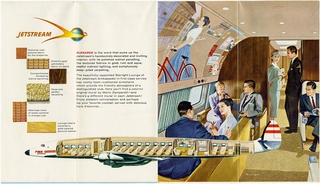
Named the “Jetstream” by TWA (Trans World Airlines), the L-1649 Starliner had a 100-passenger capacity and could cruise at a speed of 300 mph. Lufthansa and Air France were the only carriers besides TWA to operate it on the transatlantic route. #WingWednesday
This tweet was posted on June 09, 2021.
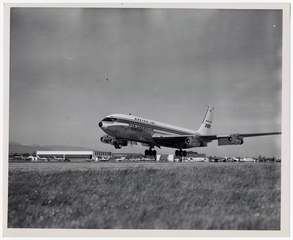
The Boeing 707 was originally developed following an initial request in 1955 from Pan American World Airways for a large capacity jet-powered airliner. #WingWednesday
This tweet was posted on June 23, 2021.
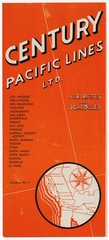
The airline was a major tenant for Mills Field, carrying just over 10,000 passengers along its routes between June and September of 1931.
(Check out those one-way airfares!)
This tweet was posted on June 22, 2021.
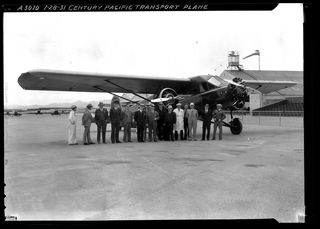
The airline, though, was short lived - it was taken over by American Airways (later American Airlines) in April 1932 and ceased operations in San Francisco the following month.
This tweet was posted on June 22, 2021.
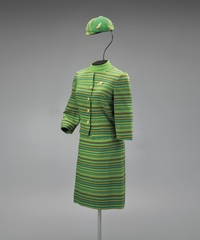
Mid-1960s airline fashion showcased bright and colorful, patterned fabrics for the first time in the industry. In 1967, Starflite Uniforms created an ensemble patterned in bold stripes for Northwest Orient Airlines. #FlightPatterns
This tweet was posted on June 10, 2021.
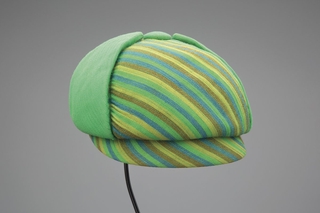
Worn as a summer uniform until 1971, it was nicknamed “The Caterpillar” by Northwest Orient Airlines flight crew and included a striped trapper hat with green side flaps. #FlightPatterns
This tweet was posted on June 10, 2021.
📸:
Northwest Orient Airlines uniform 1967
Starflite Uniforms
Hat by Mae Hanauer
Dress: Gift of The Museum of Flight
Hat: Gift of Northwest Airlines History Center
Jacket insignia: Gift of the Captain John B. Russell Family
Hat insignia: Gift of Matthew Blakley
This tweet was posted on June 10, 2021.
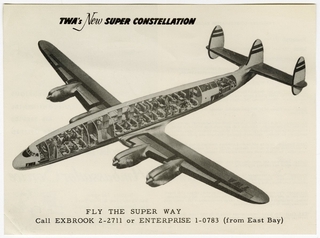
The L-1049's cabin was divided into multiple sections to minimize the effect of the long-tube view when looking up from one's seat. With a 100-passenger capacity, the airliner had a range of 4,000 miles and a cruising speed of 300 miles. #WingWednesday
This tweet was posted on May 26, 2021.
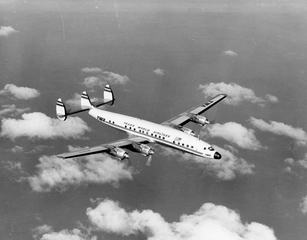
The L-1649 Starliner, the final variant in Lockheed’s Constellation-based design series, embodied the zenith in large-capacity, piston-engine airliner development, rivaled only by the Douglas DC-7C, with which it was designed to compete. #WingWednesday #avgeek
This tweet was posted on June 09, 2021.
📸:
All: @flySFO
Most: Transfers
construction; 1952
2011.032.0292
aerial view; May 19, 1954
1997.52.045.011
United Air Lines, Douglas DC-7; late 1950s
Gift of United Airlines Archives
1999.047.254
aerial view; May 1954
2011.032.0393
interior; 1962
2011.032.0770
This tweet was posted on May 25, 2021.
Not one, but TWO exhibitions and galleries opened this week! #FlightPatterns, looks at how social change affected airline uniforms in the 1960s-70s, and #StonewareStories examines the unique folk pottery produced in Edgefield, South Carolina, in the 19th and early 20th centuries.
This tweet was posted on May 28, 2021.
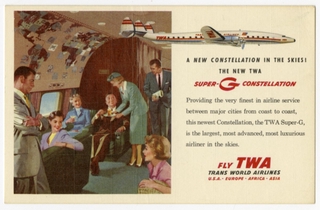
The L-1049G Super Constellation variant, introduced into service in 1955 by TWA (Trans World Airways) and Northwest Orient Airlines, was the ultra long-range version of the aircraft. #WingWednesday
This tweet was posted on May 26, 2021.
📸 1/3:
TWA, L-1049 at SFO; c. 1954
Transfer
1993.07.41
Northwest Airlines, L-1049; early 1950s
Gift of M.D. Klaas
2018.112.0248
TWA, L-1049; 1950s
Gift of Thomas G. Dragges
2015.165.890
ad: L-1049; 1951
Purchase
2011.171.001
This tweet was posted on May 26, 2021.
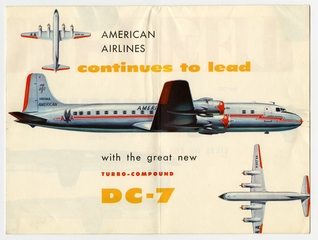
The DC-7 was Douglas Aircraft’s last design evolution of the piston-powered, four-engine, low-wing airliner layout that began with the DC-4. In 1953, American Airlines introduced the DC-7 as its first nonstop, transcontinental airliner. #WingWednesday
This tweet was posted on June 02, 2021.
📸 1/3:
American, DC-7; 1953
Gift of M.D. Klaas
2018.112.1186
American, DC-7B, SFO; 1958
Gift of William T. Larkins
2004.051.003
United, DC-7; c. 1956
Gift of United Airlines Archives
2000.150.006
Airmail flight cover; June 1, 1954
Gift of Capt. Jon Simmonds
2014.156.214 a b
This tweet was posted on June 02, 2021.
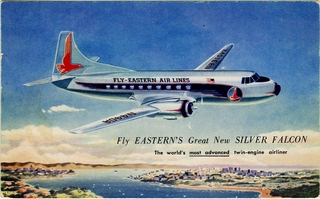
Eastern Air Lines ordered sixty of the 4-0-4 and introduced the aircraft in 1951, with scheduled service commencing in early 1952. The airline operated the 4-0-4 primarily on its eastern U.S. routes and branded the service as the “Silver Falcon.” #WingWednesday
This tweet was posted on May 19, 2021.
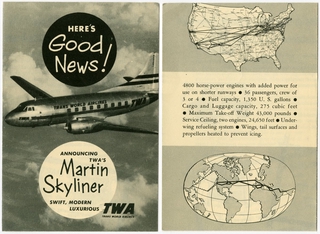
TWA (Trans World Airlines) was the only other major carrier to order the Martin 4-0-4, and operated a fleet of forty. Other airlines operating the 4-0-4 included Southern Airways and Piedmont Airlines. #WingWednesday
This tweet was posted on May 19, 2021.
📸 2/2
All: Martin 4-0-4
TWA; c. 1950
Gift of Thomas G. Dragges
2015.165.885
Southern Airways over Atlanta; 1960s
Gift of Thomas G. Dragges
2015.166.1350
Piedmont Airlines, Atlanta Airport; 1960s
Gift of Thomas G. Dragges
2015.166.1790
This tweet was posted on May 19, 2021.
📸:
Trans World Airlines uniform; 1965
Pierre Balmain
Hat by Mae Hanauer
Gift of TWA Clipped Wings International, Inc.
2002.113.054
Cathay Pacific Airways uniform; 1974
Pierre Balmain
Gift of Cathay Pacific Airways
2009.060.028-.033
This tweet was posted on May 18, 2021.
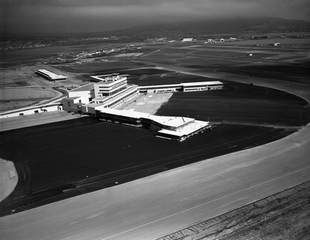
As the airline industry grew in the late 1940s-50s, construction of a new terminal @flySFO began in 1951. Designed in the International Style, the 7-story building employed an innovative, dual-level layout that separated departures from arrivals. #SFO1954
This tweet was posted on May 25, 2021.
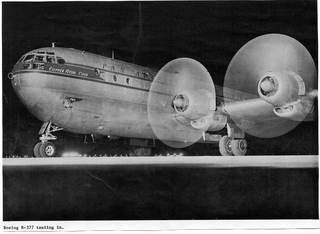
The Boeing 377 Stratocruiser was considered the most luxurious airliner aloft when introduced by Pan American World Airways in 1949. #WingWednesday
This tweet was posted on May 12, 2021.
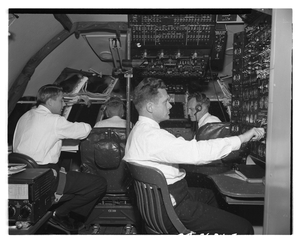
With nineteen windowpanes, the cockpit of the Boeing 377 offered one of the highest degrees of visibility of any airliner. #WingWednesday
This tweet was posted on May 12, 2021.
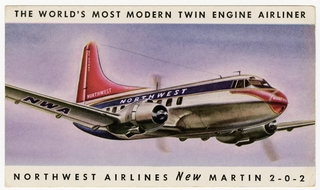
Developed by the Glenn L. Martin Company, the Martin 2-0-2 was intended to supersede the DC-3. Although early orders placed in 1945 were canceled due to production delays, the 2-0-2 was introduced into service by Northwest Airlines in October 1947. #WingWednesday #avgeek
This tweet was posted on April 28, 2021.
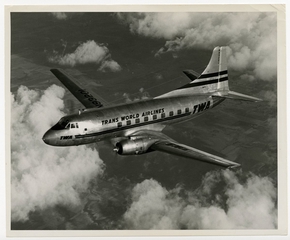
Though only 47 were built, the Martin 2-0-2 was flown by airlines such as Northwest Airlines, Pacific Air Lines, Trans World Airlines, and Allegheny Airlines. #WingWednesday #avgeek
This tweet was posted on April 28, 2021.
📸:
aircraft information: Northwest Airlines, Martin 2-0-2; c. 1947
postcard: Northwest Airlines, Martin 2-0-2; 1949
Gift of Thomas G. Dragges
2015.160.613 & 2015.166.1129
TWA (Trans World Airlines), Martin 2-0-2; c. 1950
Gift of M.D. Klaas
2018.112.0890 & 2018.112.0891
This tweet was posted on April 28, 2021.
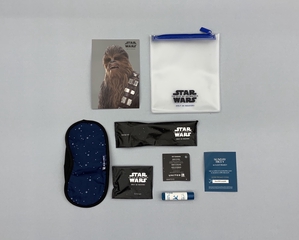
Well, would you Wookiee at that! Two years ago, United gave away Star Wars branded amenity kits to their Polaris-class passengers.
📸:
amenity kits: United Airlines; 2019
Gift of Vincent Ma
2021.020.0885-0888
#MayTheFourth #StarWars #PaxEx
This tweet was posted on May 04, 2021.
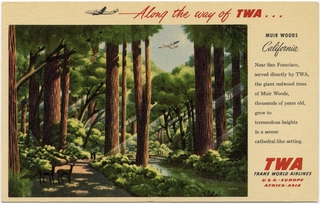
It's National Parks Week! The wonder, beauty, and magnificence of our country's national parks make them popular imagery in airline advertisements, even going back to the 1930s. #NationalParkWeek #AvGeek
This tweet was posted on April 20, 2021.
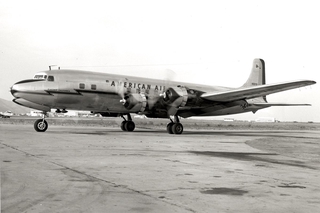
Introduced by United Air Lines and American Airlines in 1946, the DC-6 was the first new American-designed airliner to operate during the postwar years. #WingWednesday #avgeek
This tweet was posted on April 21, 2021.
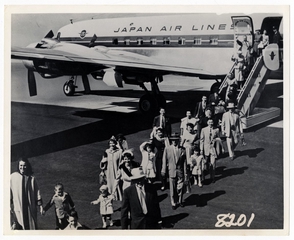
One of the most economical large propliners to operate during the postwar period and beyond, over 700 Douglas DC-6 were built and added to airline fleets worldwide. #WingWednesday #avgeek
This tweet was posted on April 21, 2021.
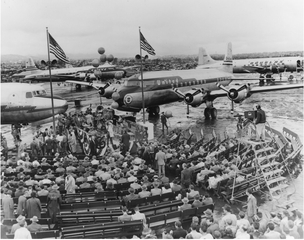
The Douglas DC-6 was initially conceived of as a military transport but its design was changed to a civilian airliner following the end of WWII. It was fundamentally an updated, enlarged, and pressurized DC-4 built to compete with the Lockheed L-049 Constellation. #WingWednesday
This tweet was posted on April 21, 2021.
📸 1/4:
United, American, Douglas DC-6 ceremony; c. 1946
Gift of United Airlines Archives
1999.047.255
Pan Am, DC-6B “Clipper Liberty Bell”; c. 1950
Transfer
1993.03.07
American, DC-6B, @flySFO; 1953
Gift of William T. Larkins
2000.026.001
This tweet was posted on April 21, 2021.
📸 2/4:
United, DC-6; c. 1950
Gift of the Intrepid Sea, Air & Space Museum
2008.060.009
United, DC-6A; c. 1950
Gift of United Airlines Archives
1999.047.158
Northern Air Cargo, DC-6B-ST; c. 1970
Gift of the Pan Am Association
2000.058.0472.040
This tweet was posted on April 21, 2021.
📸:
TWA (Trans World Airlines), Muir Woods; early 1950s
Gift of TWA Clipped Wings International
2002.113.497
TWA (Trans World Airlines), Yosemite; c. 1950
Gift of Thomas G. Dragges
2014.110.375
timetable: National Parks Airways; 1936
Purchase
2000.055.006
This tweet was posted on April 20, 2021.